
Presentation
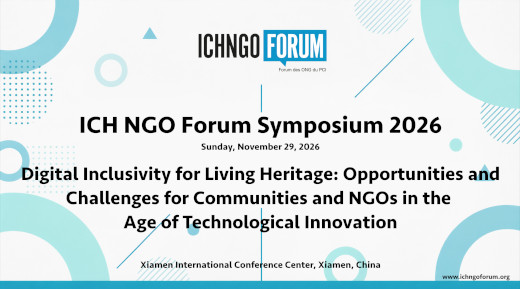
As digital technologies increasingly influence how intangible cultural heritage is documented, transmitted, interpreted, shared and governed, it is essential to ensure that the communities, groups and individuals concerned remain at the center of safeguarding processes. Digital tools can create new opportunities for participation, visibility, transmission, education and collaboration while preserving community agency, contextual understanding and cultural meaning. At the same time, they can also deepen inequalities, reinforce exclusion, facilitate the appropriation of cultural knowledge, and weaken community decision-making over cultural expressions.
Through case studies and reflections from around the world, the 2026 symposium responds to current challenges in safeguarding ICH and to growing international discussions on cultural rights in digital environments. The 2025 Report of the United Nations Special Rapporteur in the field of Cultural Rights, Artificial Intelligence and Creativity, has highlighted the importance of meaningful participation, cultural diversity, transparency and community consent in the development and use of digital technologies, including artificial intelligence. Moreover, drawing on UNESCO’s initiatives ‘Dive into Heritage’ and ‘Leveraging the Support of UNESCO’s Networks on Artificial Intelligence and Emerging Technologies’, it is strongly believed that digital innovation must strengthen the rights of communities to maintain, develop, and transmit their heritage on their own terms.
Zoom Meeting: click here
Meeting ID: 879 8295 2245
Passcode: 547116
09:00 – 9:45. Welcome Speeches & Opening Remarks
Opening of the Symposium
Fumiko Ohinata – Secretary of the 2003 Convention
Symposium presentation
Matti Hakamäki – Chair of the Executive Board of the ICH NGO Forum
Keynote: Algorithmic colonialism and living heritage rights
Pier Luigi Petrillo – Cultura Italiae Association and UNESCO Chair on Intangible Cultural Heritage and Comparative Law, Italy.
9:45 – 11:00. Session 1. Digital Inclusivity for Living Heritage
Moderators: Alain Muneean & Masha Vukanovic
Who Decides What Goes Online? Community Digital Inventories and TK Labels for the Living Pictures of Galeras, Colombia
Diana Teresa Gutiérrez García – Embodying Reconciliation / Cuerpos para la Reconciliación, Colombia.
« Twiza n Ammi Brahim » : quand le volontariat communautaire traditionnel rencontre le numérique pour sauvegarder un patrimoine vivant (vallée du M’Zab, Algérie)
Aoumeur Bakelli & Ahmed Bouhoun – Association imekres pour le patrimoine et le folklore, Algérie.
Hack the Heritage: Co-Creating Digital Pathways for Safeguarding Living Heritage
Meerim Aitkeeva – Aigine Cultural Research Center, Kyrgyztan.
Co-Creating Web Documentaries with Communities for Digital Heritage Safeguarding: The Case of the Chinese Spring Festival
Jing Wang – China, France
Visible Is Not Free: Consent, Living Heritage and AI
Ahmet Akcan – Traditional Arts Association, Türkiye
Q&A session
11:00 – 11:15. Coffee Break
11:15 – 12:15. Panel 1. Living Heritage, Ethics and AI
Moderators: Martín Andrade-Pérez & Carley Williams
Ľudo Slovenský: Crowdsourcing the Digital Return of Folk Song Heritage – Balancing AI and Human Expertise
Jana Ambrózová – Citizen-led initiative “Ľudo Slovenský”, Slovakia.
When the last master speaks through AI: Kujundzija.info and community-centered digital safeguarding of traditional goldsmithing in North Macedonia
Snezana Mircevska Damjanovska – Macedonian Research Society, North Macedonia.
AI opportunities and Challenges on Kazakh embroidery in Changji, Xinjiang
Xiaoyu HU – Xinjiang Intangible Cultural Heritage Studies Centre, China.
How is Living Heritage Represented Online? The Digital Mediation of Coral and Cameo Craftsmanship in Torre del Greco
Sara Di Luca – Cultura Italiae Association and UNESCO Chair on Intangible Cultural Heritage and Comparative Law, Italy.
12:15 – 13:15. Lunch, accompanied by a session of pre-recorded presentations (List of presentations at the end of this programme)
13:15 – 14:30. Session 2. Documentation and Archiving Living Heritage through Inclusive Digital Strategies
Moderators: Océane Lesot & Léonce Ki
We may have more photographs than ever, but do we truly have more memories?
Shinwha Hong – The Center for Intangible Culture Studies, South Korea.
A New Day for Archives of ICH through Online Websites Enabling Community Engagement
Robert Baron – International Society for Ethnology and Folklore, United States.
Digital Memory for Malay Dance Communities in Singapore
Noramin Farid – National Heritage Board, Singapore.
From Living Heritage to Digital Inclusivity: Lessons from Safeguarding Indonesian Batik
Ary Basoeki Albertus – Yayasan Batik Indonesia (YBI) / The Indonesian Batik Foundation, Indonesia.
Community-Based Digital Documentation of Living Heritage: Benefits and Challenges — A Case Study of the Jahla Project in Southern Iran
Tahereh Rezaei & Abdolhossein Rezvani – Hormozgan Cultural Heritage Custodians Association (HCHCA), Iran.
Q&A session
14:30 – 14:45. Coffee Break
14:45 – 16:00. Panel 2. Digital Innovation for Participation
Moderators: Pier Luigi Petrillo & Jana Ambrózová
“Add Your Perspective” in the Inventory of Intangible Cultural Heritage in the Netherlands
Saskia van Oostveen – Dutch Centre for Intangible Cultural Heritage (KIEN), The Netherlands.
Inclusive Digital Revival of Charyapada by Regional Practitioners
Mohammad Shariful Islam Saymon Zakaria & Tania Biswas. Vabnagar Foundation, Bangladesh.
The Last Mile: Government-NGO Partnerships for Heritage Businesses
Chester Matthias Tan – Heritage Business Foundation, Singapore.
From Monument to Living Heritage. Community-Based Digital Communication and Representation of Intangible Cultural Heritage in Borobudur, Indonesia
Hernowo Muliawan – Stuppa Indonesia Foundation, Indonesia
Participatory Mapping and Data Visualisation: Digital Inclusion for the Living Culture of Cognac
Vanessa Martin Ferey – Cognac Heritage and Know-How Association, France.
School Talks, Arts and Digital Inclusion: Pathways to Safeguarding Living Heritage in Grenada
Adriana Rojas Kerezsy – Grenada National Trust, Grenada.
16:00 – 16:30. Closing Remarks. End of the Symposium
Organizing Committee / Working Group Research
Pre-recorded presentations:
Documenting on their own terms: Supporting community-led digital documentation of contested living heritage
Laura Danckaert & Jordy Skropinski – Centre for Agrarian History, Belgium.
From the Village to the Digital Archive: Documenting Living Musical Heritage in Moldova
Gheorghe Șova – NGO “Alianța între generații”, Republic of Moldova.
Digital Cultural Heritage: Imagination, innovation and opportunity
Ian Thomas – The British Council, United Kingdom
From Visibility to Voice: Multi-Stakeholder Negotiations in the Digital Popularisation of Zanhuawei in China
Ziwei Ouyang – Deakin University, Australia
Digital technologies for iIntangible Cultural Heritage:opportunities and calls for communities in the technological innovation era
Oksana Buturlina – NGO “WOMEN plus”, Ukraine
Analog Grounds, Digital Echoes: Vernacular Media, Relational Governance, and the Embodied Limits of Jemparingan
Monique Pilapil – De La Salle – College of Saint Benilde, Creative Industries Management Program, Philippines.