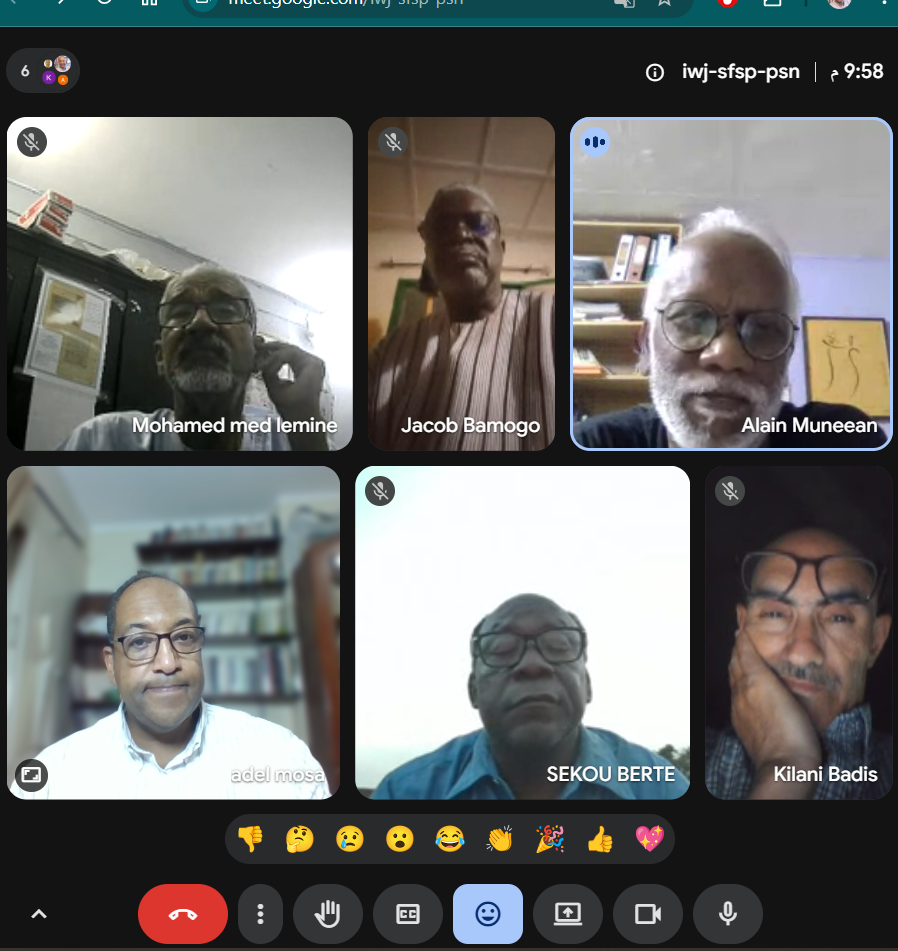
The Committee for More Balanced Geographical Representation of NGOs, operating under the Forum of NGOs for Intangible Cultural Heritage, held its periodic meeting on the evening of Saturday, May 30, 2026, via video conferencing platform, between 8:00 and 10:00 PM Paris time, with the participation of committee members from various geographical regions.
The meeting was chaired by the Committee President, Mr. Mohammed Al-Amin, who opened the session by welcoming the attending members, emphasizing that this meeting comes at a critical juncture given the approaching UNESCO General Assembly to be held in Paris in June 2026. Subsequently, the Committee Secretary, Mr. Adel Moussa, presented the work agenda and roadmap for the upcoming period, highlighting the projects the Committee intends to launch with the aim of bridging the gap between different communities and fostering rapprochement and cooperation among them. The meeting was attended by a distinguished group of experts and specialists in the field of intangible cultural heritage, namely Professor Sekou Berté, former President of the Executive Council of the NGO Forum and Committee member; Mr. Alain Muneean, former Committee President and current Executive Council member; Mr. Jacob Bamogo, heritage expert and Committee member; and Mr. Kilani Salem, heritage expert and Committee member.
During the meeting, Mr. Alain Muneean presented statistical data illustrating the extent of geographical disparity in representation within the framework of the 2003 Convention for the Safeguarding of Intangible Cultural Heritage. He revealed that out of 96 NGOs that submitted accreditation applications to UNESCO, only 59 organizations were accredited. Regarding African representation, the entire continent — encompassing 54 countries — is represented by only 27 accredited organizations, with numerous African countries having absolutely no representation in this system whatsoever. He further noted that the situation in Arab countries has yet to be subject to a comprehensive statistical study, which the Committee is working to complete as soon as possible. Members described this reality as “a structural problem requiring radical solutions,” stressing that the gap between the Convention’s provisions and their actual implementation on the ground remains wide in many countries.
In the course of the meeting, an achievement described by members as “historic” was announced: for the first time in the Forum’s history, the NGO Forum has secured the right to speak for ten minutes during the upcoming UNESCO General Assembly in Paris next month. Furthermore, an explicit reference to the Forum’s efforts in enhancing the geographical representation of regions was included in the official documents prepared by the UNESCO Secretariat — an acknowledgment that members regarded as formal institutional recognition of the Forum’s role and the importance of its mission.
Members agreed to coordinate with the President of the Executive Council and former Committee President, Mr. Matti Hakamaki, to prepare a compelling and well-structured presentation that makes the best use of these ten minutes, showcasing the Committee’s journey and aspirations to the international community.
On the front of upcoming expansion opportunities, the agenda of the next UNESCO General Assembly includes the accreditation of 59 new organizations, representing a rare opportunity to broaden the base of geographical representation within the Forum. Members resolved to distribute the list of these organizations to all Committee members for study and to identify contact priorities, with particular emphasis on attracting organizations from Africa, the Arab world, Latin America, and the Caribbean into the Forum’s sphere of activities.
The strategic dimension of the meeting marked a qualitative turning point in the Committee’s vision for its future work. Members unanimously agreed on the necessity of transitioning from a posture of waiting for opportunities to one of proactively creating them, by submitting joint technical and financial offers to secure consultancies and projects available through the Secretariat of the 2003 Convention and partner international institutions. Members also stressed the importance of activating internal communication tools and regularly exchanging technical documents to maintain the group’s dynamism and effectiveness in the coming period.
Within this framework, the Committee resolved to move forward with the following priorities:
-
Preparing a proposals paper on mechanisms to enhance geographical representation, to be submitted to the Forum’s Executive Council
-
Completing the second phase of the “Geographical Mapping” project for NGOs, which is nearing its conclusion
-
Establishing a formal working team comprising Committee members to work in an integrated manner on leveraging available consultancy and project opportunities
Mr. Mohammed Al-Amin, Committee President, stated:
“What we are striving for is not merely balanced numbers — it is justice for the peoples and communities that carry within their living memory the most precious heritage that human civilization has ever produced. Today we possess the will and the competencies, and the upcoming General Assembly will be the platform through which we prove that the voice of the Global South is present and cannot be ignored.”
It is worth noting that the Committee for More Balanced Geographical Representation is one of the committees operating under the Forum of NGOs for Intangible Cultural Heritage, working within its framework to address issues of geographical balance in the accreditation of organizations active in the field of safeguarding intangible cultural heritage in accordance with the 2003 Convention.