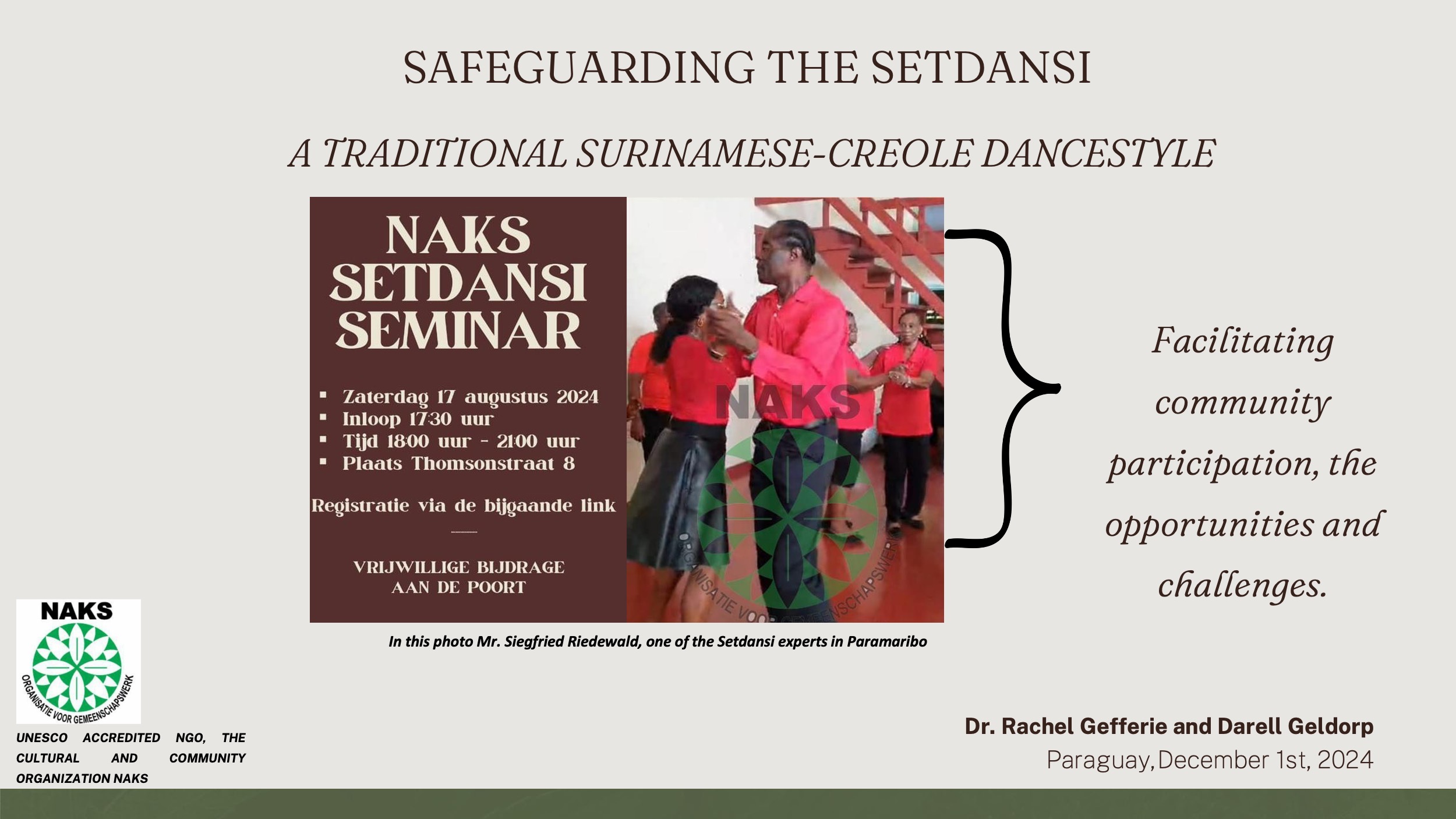
SAFEGUARDING THE SETDANSI
FACILITATING COMMUNITY PARTICIPATION, THE OPPORTUNITIES AND CHALLENGES
Dr. Rachel Gefferie and Darell Geldorp
NAKS / SURINAME
About NAKS Suriname
Since 2020, NAKS Suriname officially became an UNESCO accredited NGO. The NGO is one of the oldest (May 1947) and largest culture and community development organizations in Suriname.
How We Engage With ICH
Our mission is to bring together youngsters and adults of Afro descent and transfer the traditional knowledge and other cultural elements of our rich culture.
The safeguarding of traditional wear, language, literature, religion, rituals, craft, food, music, theatre, storytelling are some of the cultural elements that take central stage in our annual programming. The activities then serve both for cultural expressions as for documentation and preservation.
What is Setdansi?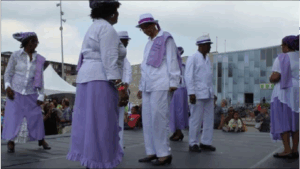
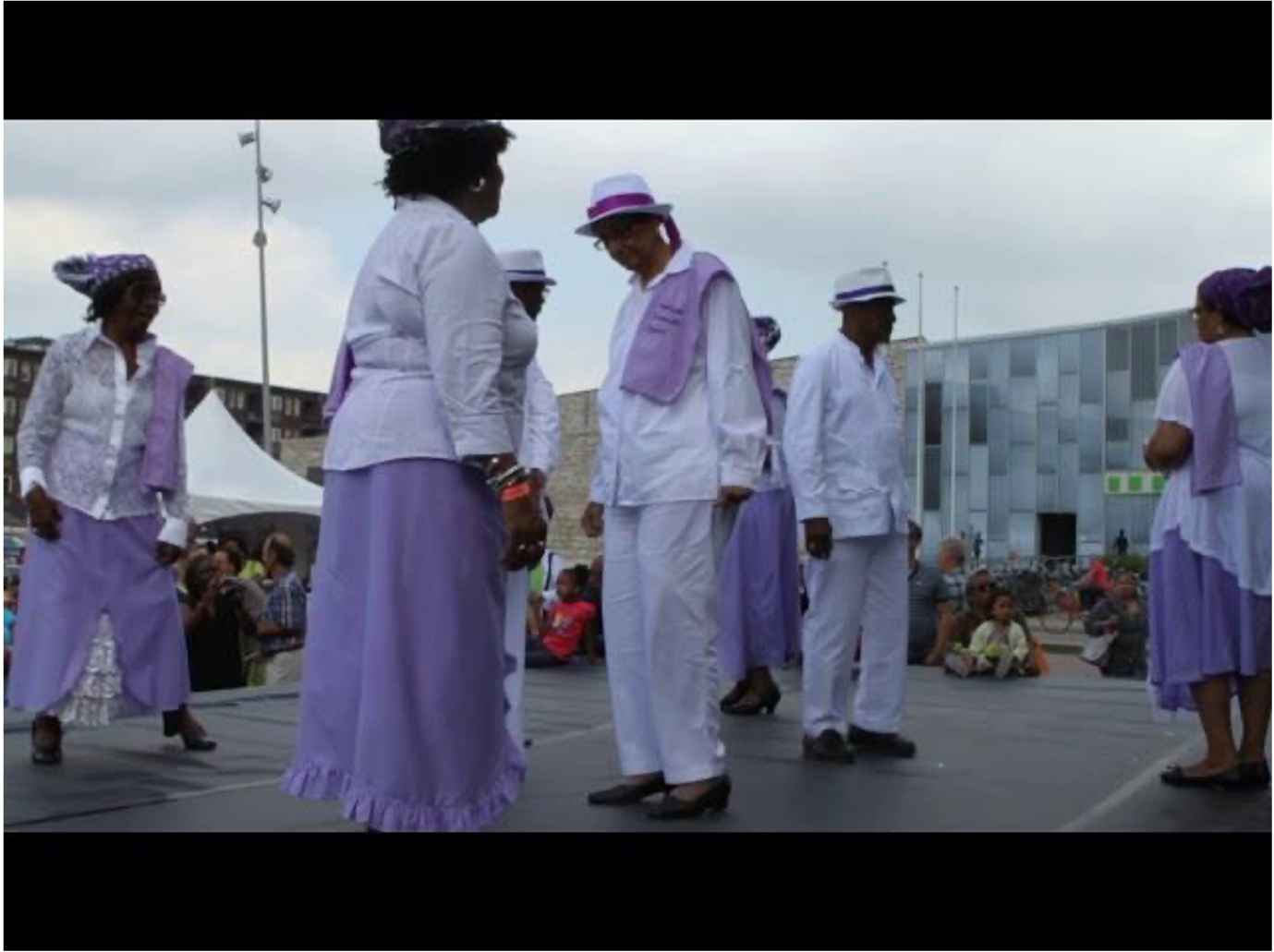
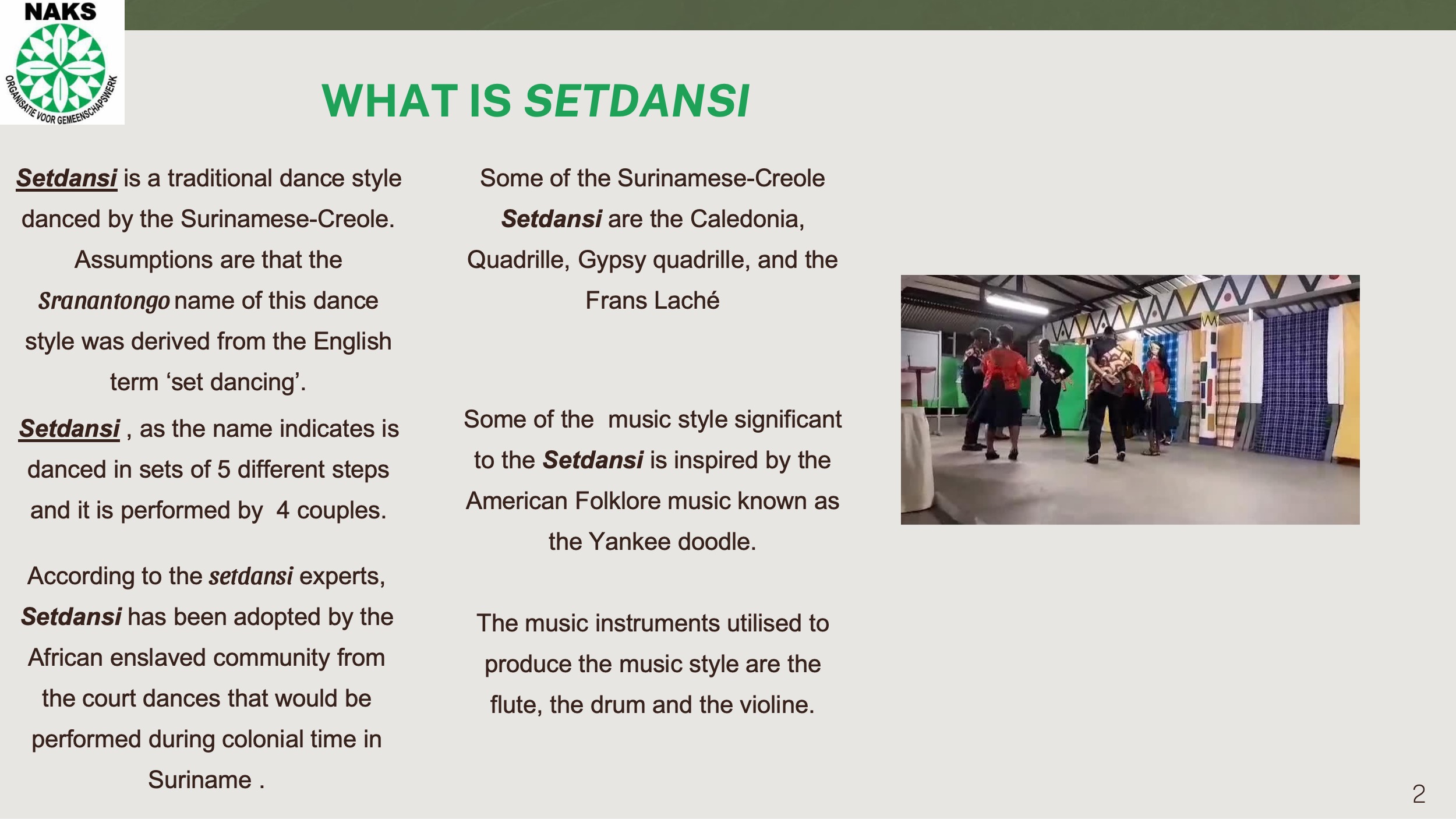
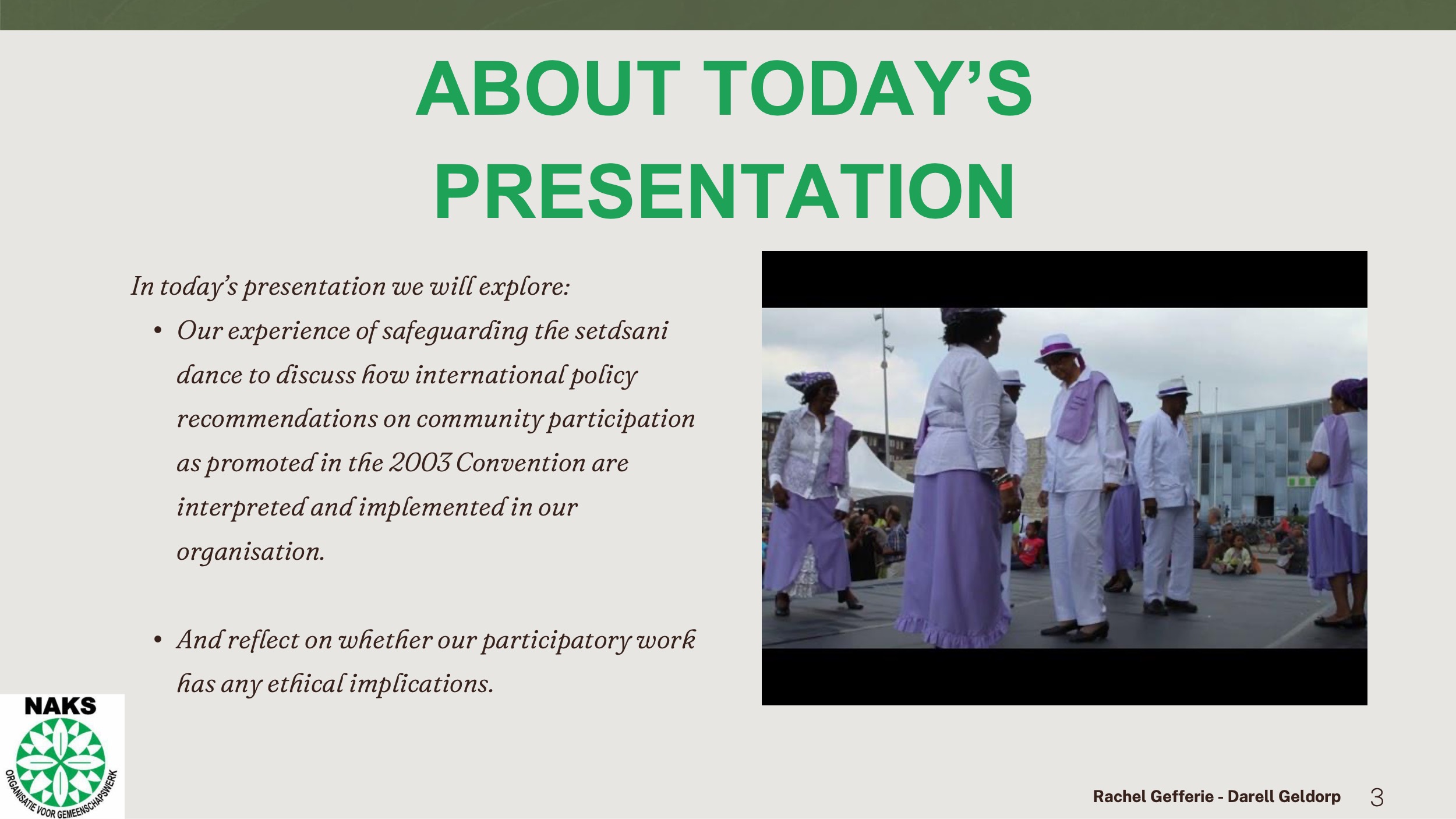
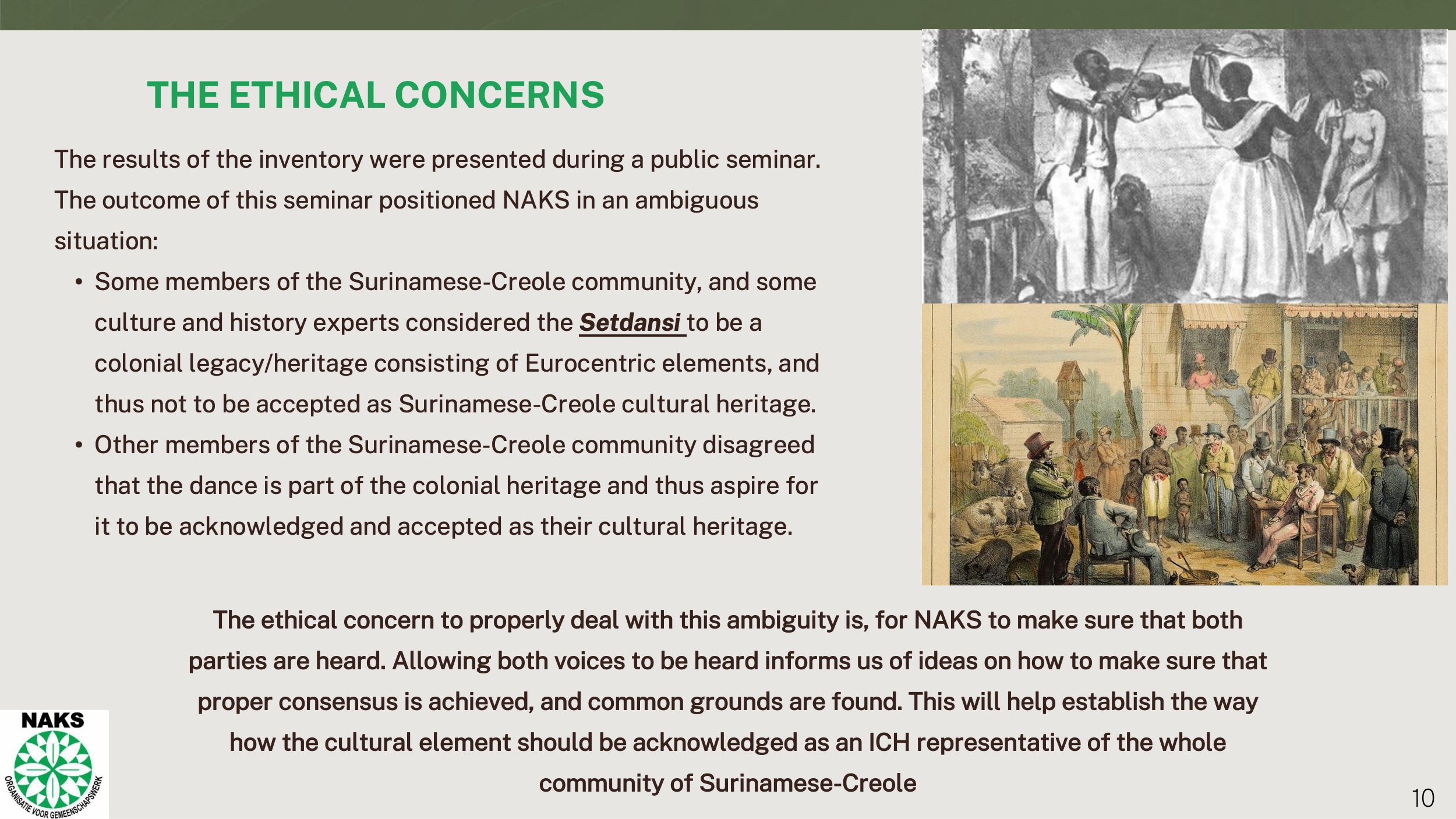
Setdansi is a traditional dance style danced by the Surinamese-Creole. Assumptions are that the Sranantongo name of this dance style was derived from the English term ‘set dancing’. Setdansi, as the name indicates is danced in sets of 5 different steps and it is performed by 4 couples.
According to the setdansi experts, Setdansi has been adopted by the African enslaved community from the court dances that would be performed during colonial time in Suriname. Some of the Surinamese-Creole Setdansi are the Caledonia, Quadrille, Gypsy quadrille, and the Frans Laché. Some of the music style significant to the Setdansi is inspired by the American Folklore music known as the Yankee doodle. The music instruments utilised to produce the music style are the flute, the drum and the violin.
About Today’s Presentation
In today’s presentation we will explore:
- Our experience of safeguarding the setdsani dance to discuss how international policy recommendations on community participation as promoted in the 2003 Convention are interpreted and implemented in our organisation.
- And reflect on whether our participatory work has any ethical implications.
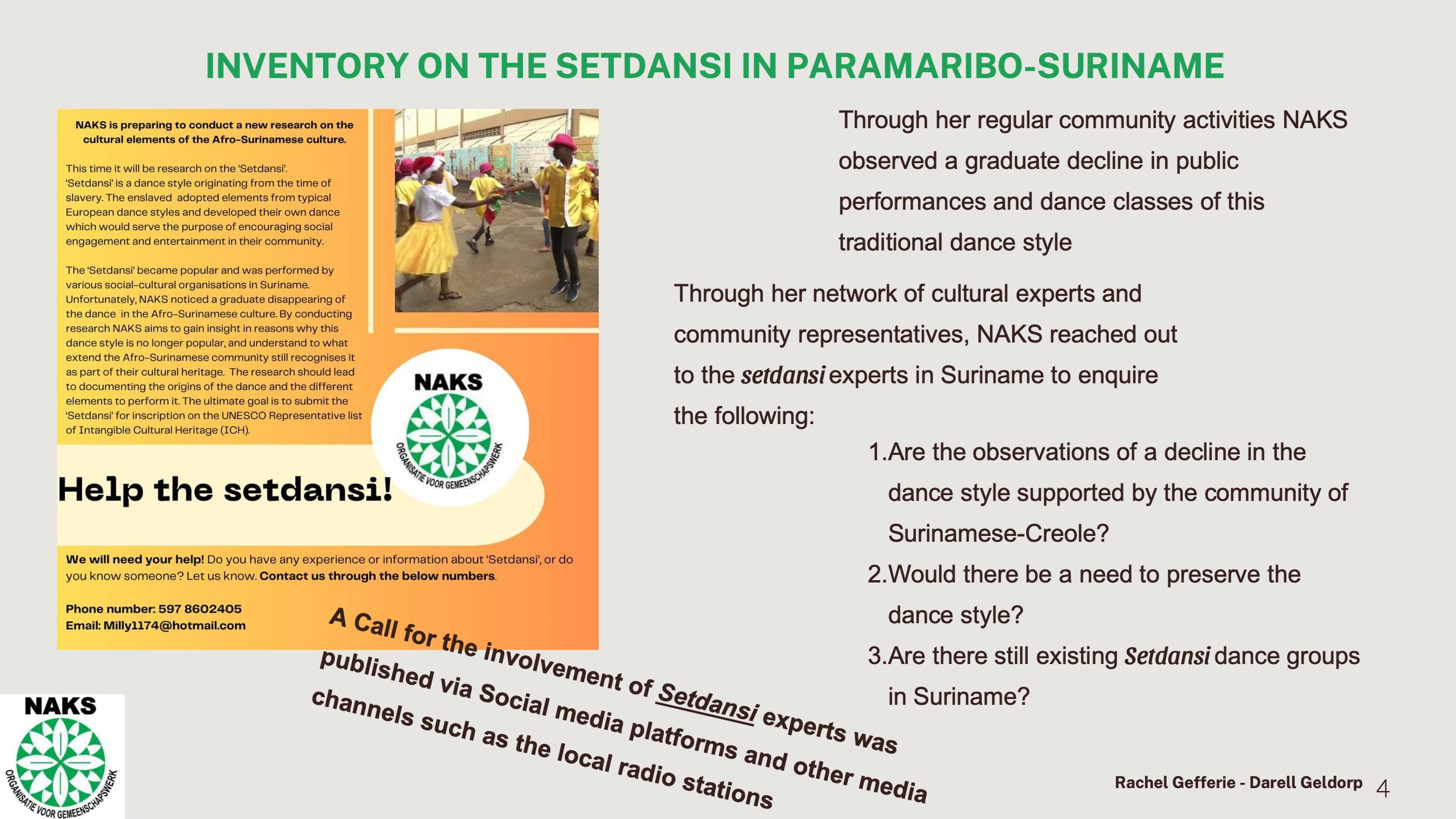
Inventory on the Setdansi in Paramaribo-Suriname
Through her regular community activities NAKS observed a graduate decline in public performances and dance classes of this traditional dance style
Through her network of cultural experts and community representatives, NAKS reached out to the setdansi experts in Suriname to enquire the following:
Are the observations of a decline in the dance style supported by the community of Surinamese-Creole?
- Would there be a need to preserve the dance style?
- Are there still existing Setdansi dance groups in Suriname?
A call for the involvement of Setdansi experts was published via Social media platforms and other media channels such as the local radio stations.
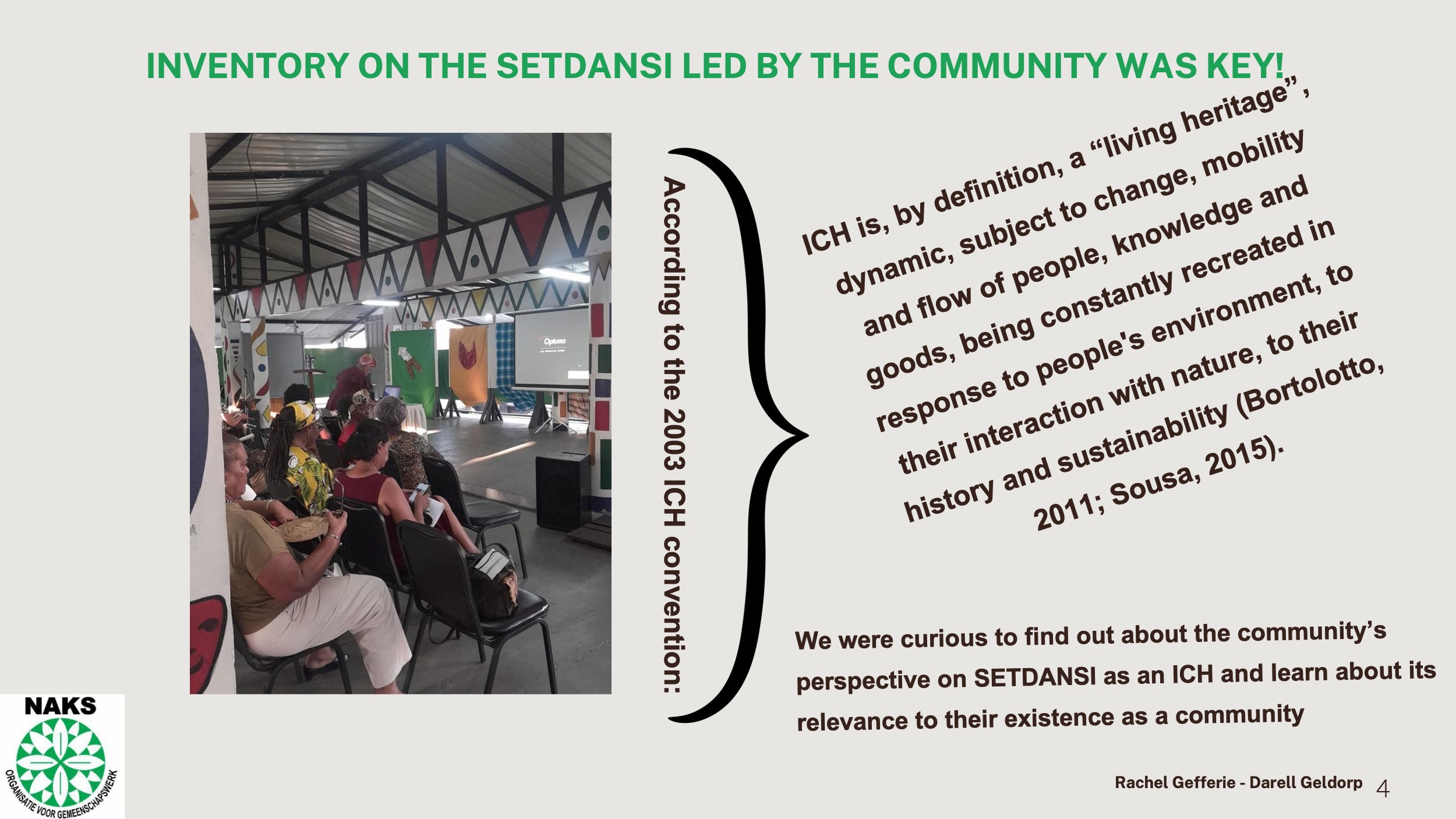
Inventory on the Setdansi Led by the Community Was Key!
According to the 2003 ICH Convention: ICH is, by definition, a “living heritage”, dynamic, subject to change, mobility and flow of people, knowledge and goods, being constantly recreated in response to people’s environment, to their interaction with nature, to their history and sustainability (Bortolotto, 2011; Sousa, 2015).
We were curious to find out about the community’s perspective on SETDANSI as an ICH and learn about its relevance to their existence as a community.
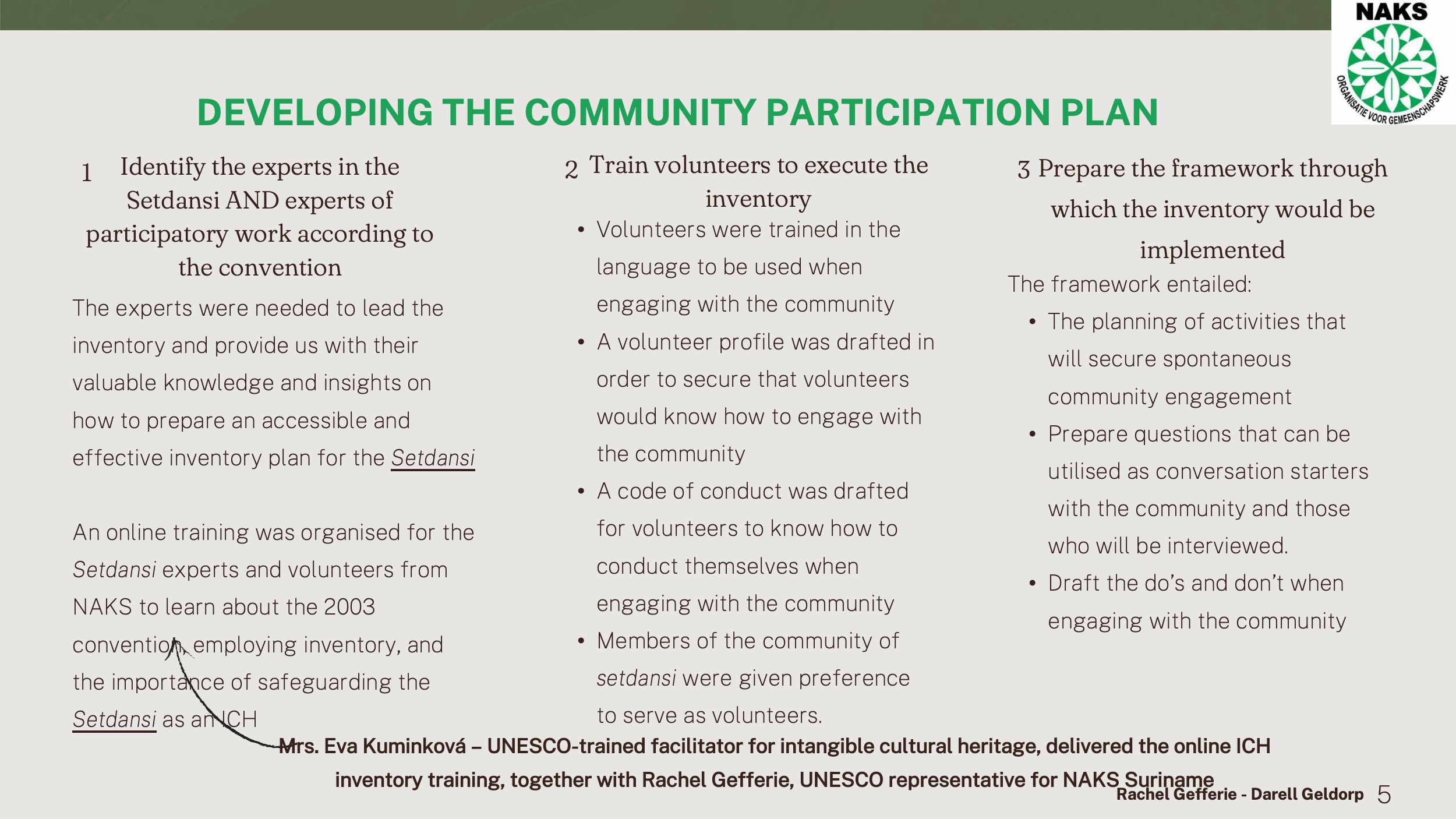
Setting Out the Community Participation Plan
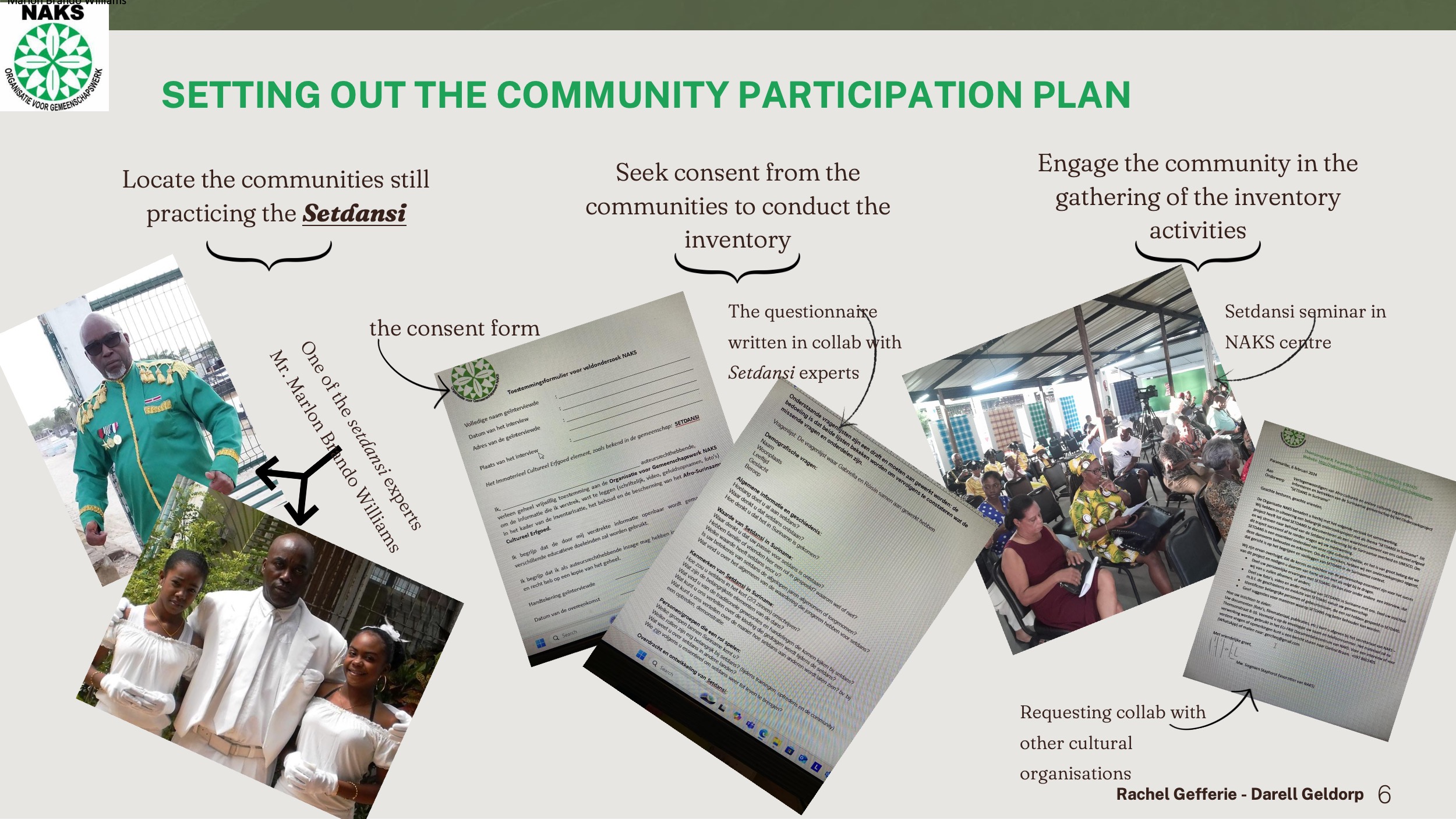
- Locate the communities still practicing the Setdansi
- Seek consent from the communities to conduct the inventory
- Engage the community in the gathering of the inventory activities
Challenges Encountered While Executing the Inventory
- Availability of volunteers with the right profile
- Availability of equipment to properly transcribe the conversations with the community and the experts
- Availability of written information about the Setdansi
- Knowledge that disappeared due to the passing of the older generation of Setdansi experts
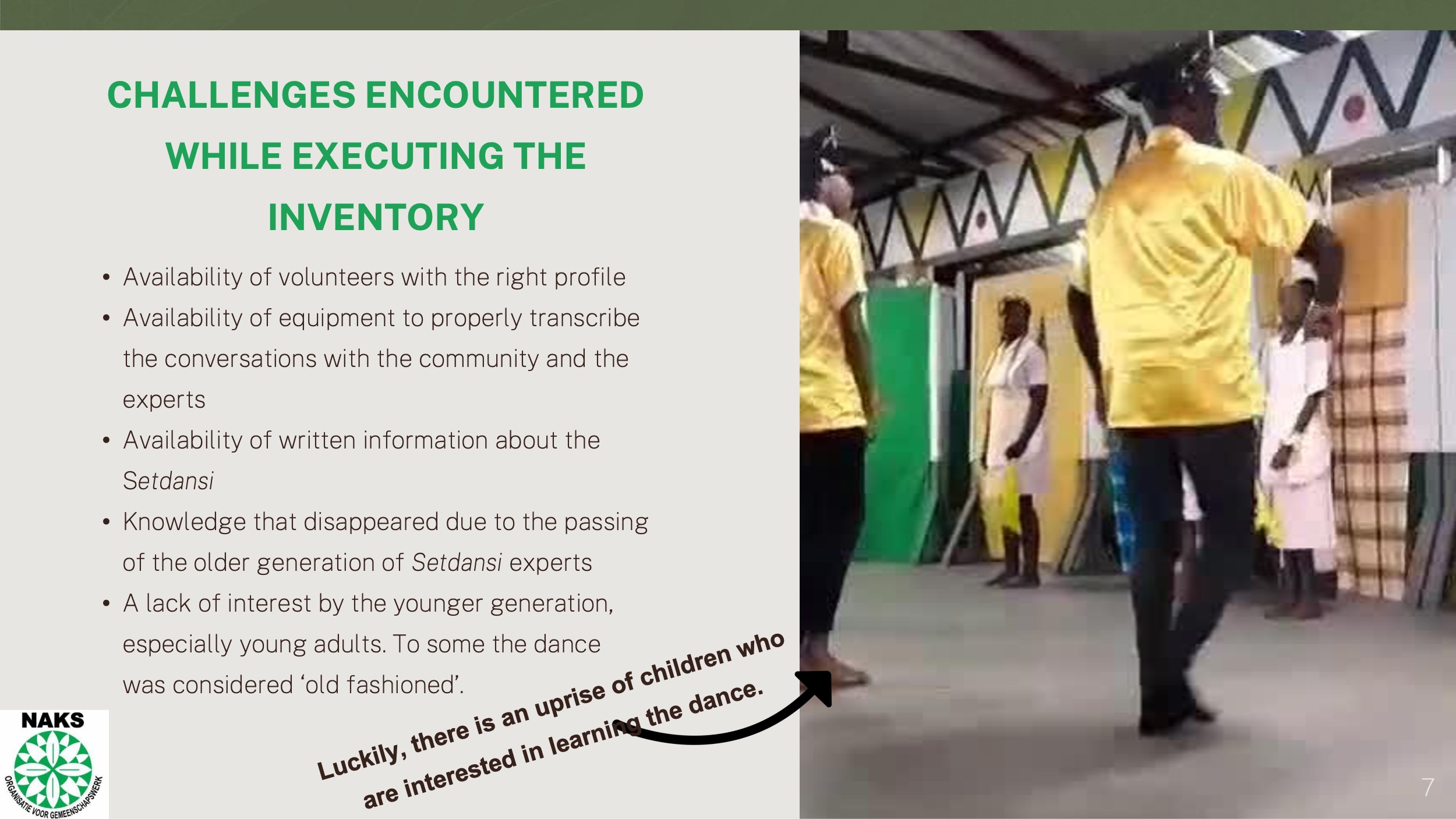
- A lack of interest by the younger generation, especially young adults. To some the dance was considered ‘old fashioned’.
Luckily, there is an uprise of children who are interested in learning the dance.
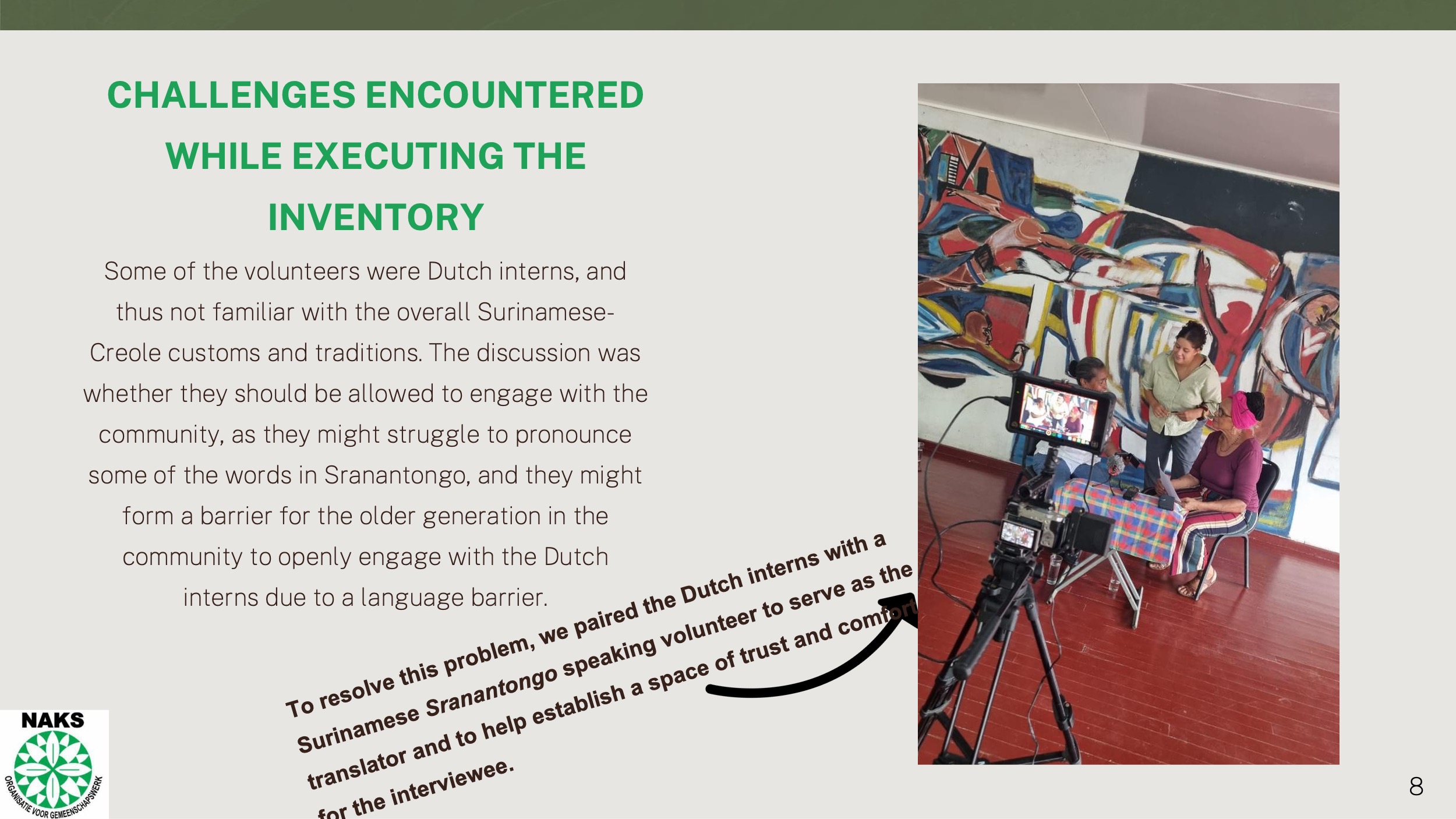
Some of the volunteers were Dutch interns, and thus not familiar with the overall Surinamese-Creole customs and traditions. The discussion was whether they should be allowed to engage with the community, as they might struggle to pronounce some of the words in Sranantongo, and they might form a barrier for the older generation in the community to openly engage with the Dutch interns due to a language barrier.
To resolve this problem, we paired the Dutch interns with a Surinamese Sranantongo speaking volunteer to serve as the translator and to help establish a space of trust and comfort for the interviewee.
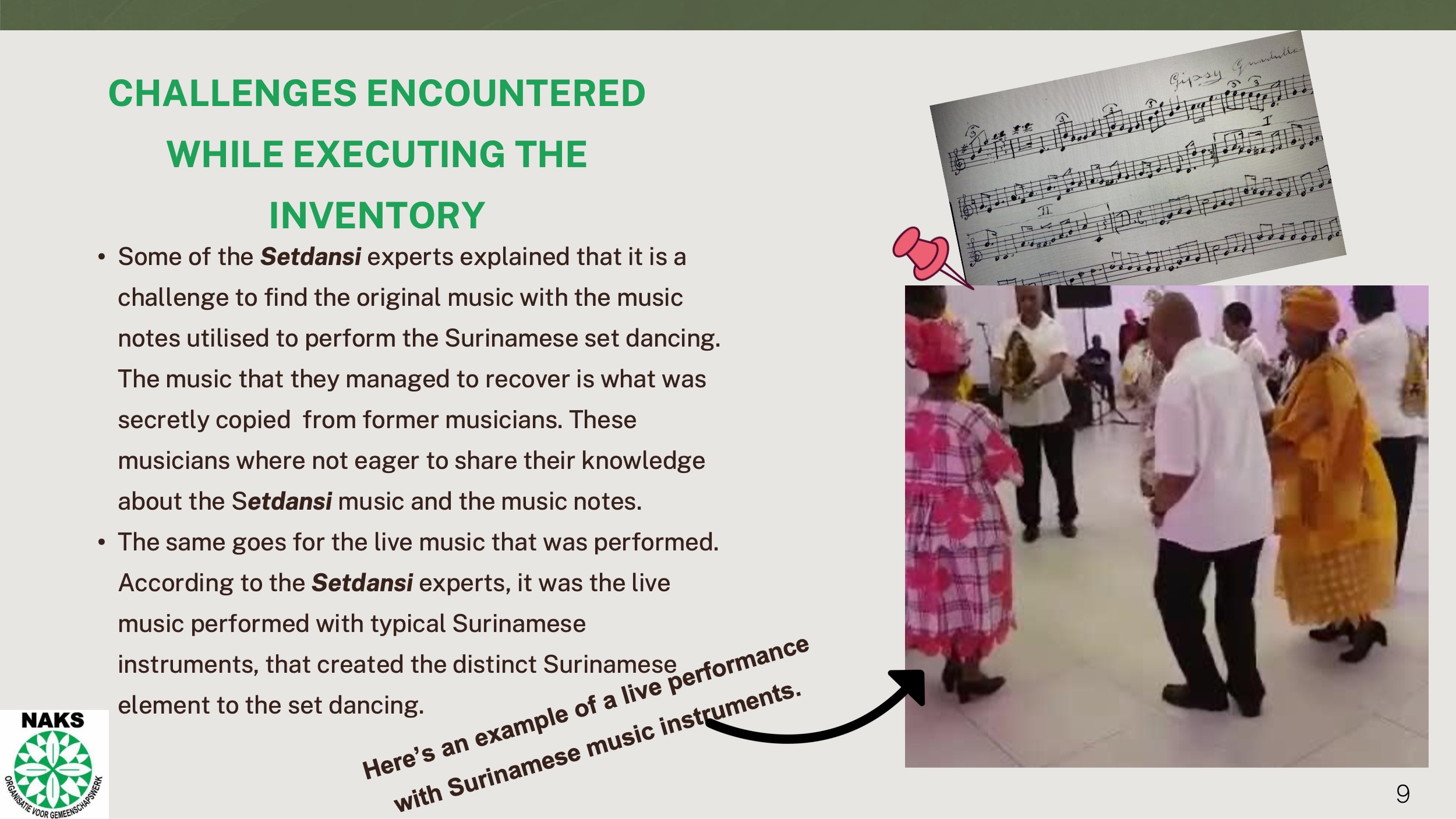
Some of the Setdansi experts explained that it is a challenge to find the original music with the music notes utilised to perform the Surinamese set dancing. The music that they managed to recover is what was secretly copied from former musicians. These musicians where not eager to share their knowledge about the Setdansi music and the music notes.
The same goes for the live music that was performed. According to the Setdansi experts, it was the live music performed with typical Surinamese instruments, that created the distinct Surinamese element to the set dancing.
The Ethical Concerns
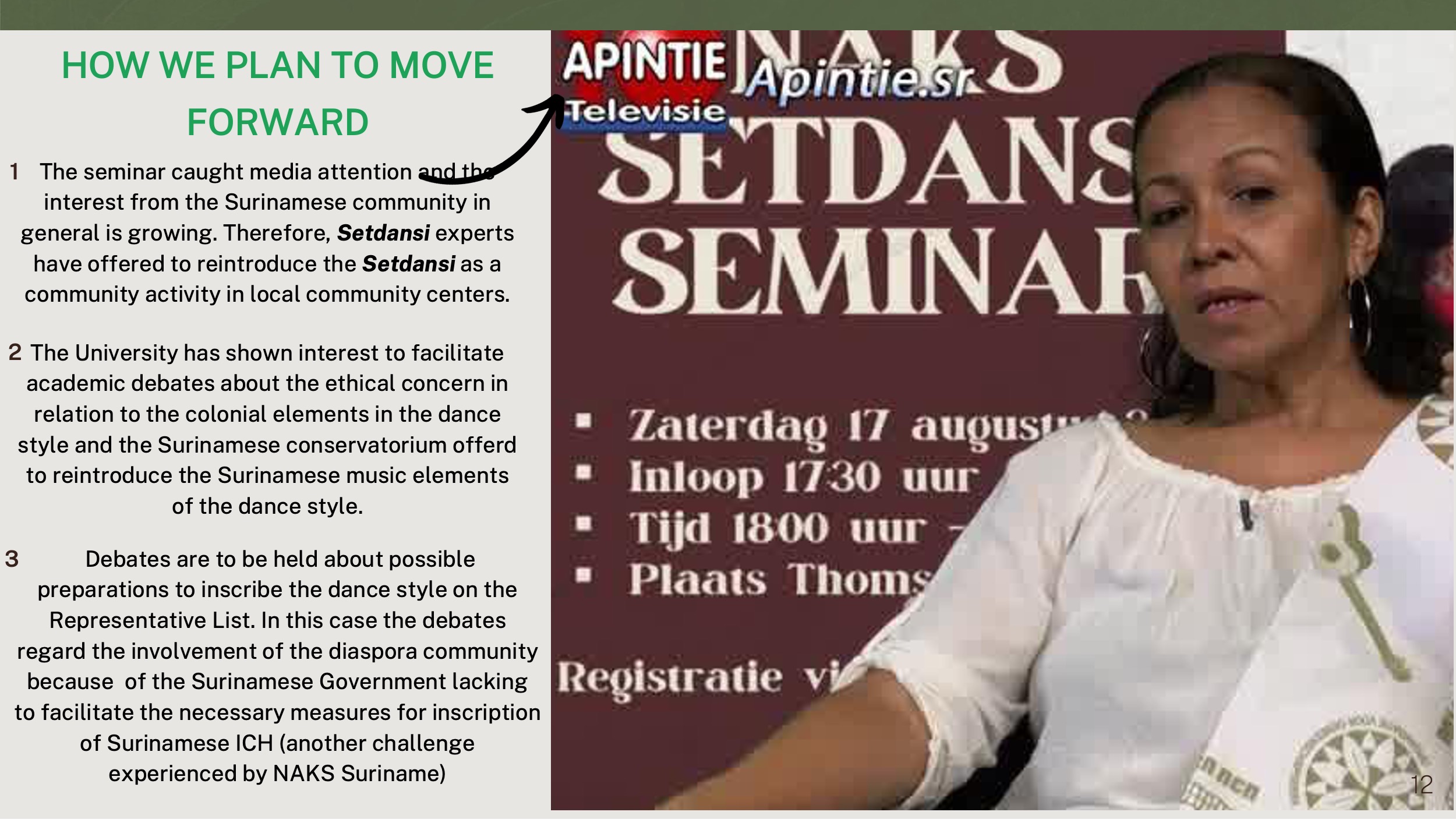
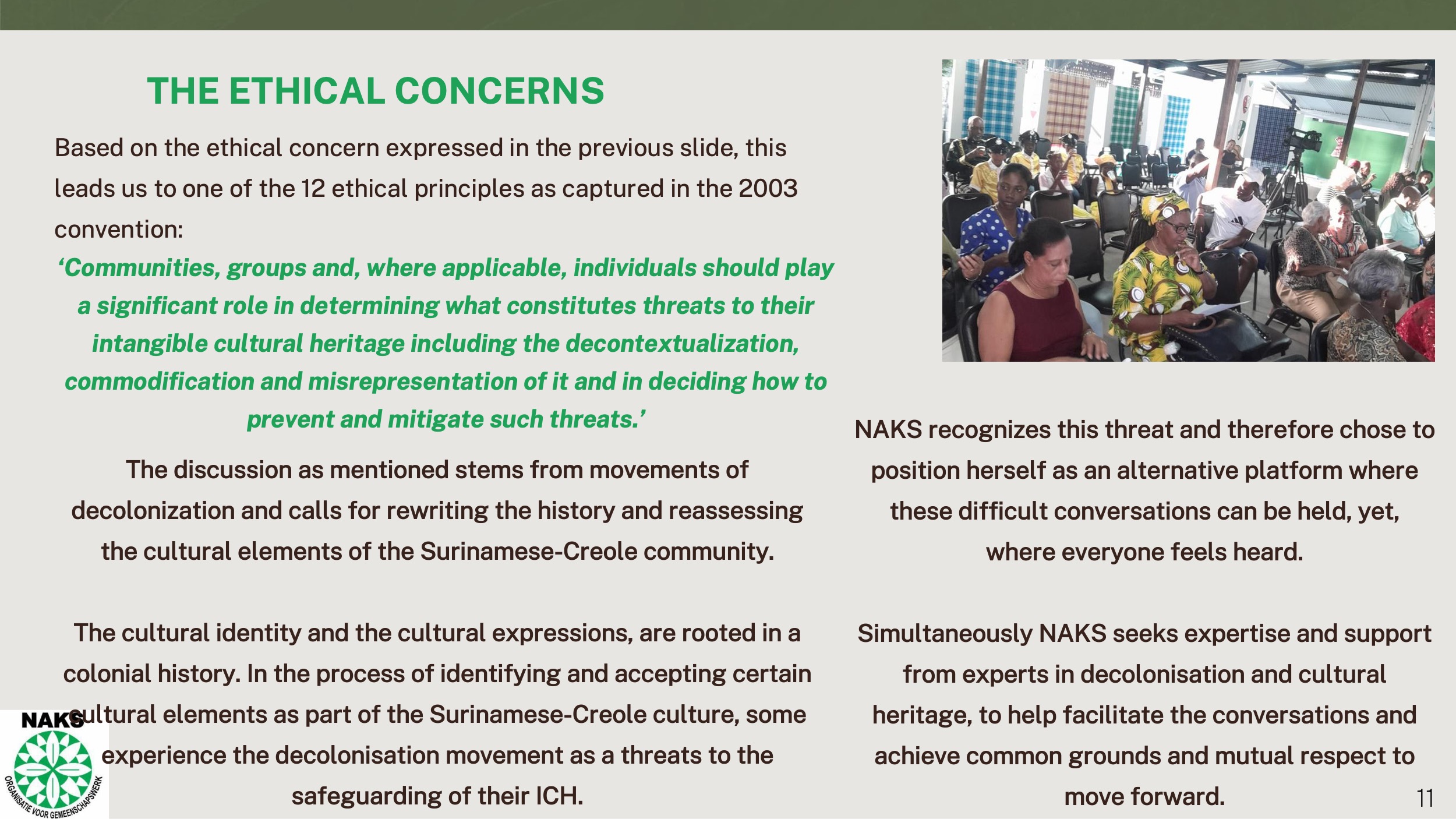
The results of the inventory were presented during a public seminar. The outcome of this seminar positioned NAKS in an ambiguous situation:
- Some members of the Surinamese-Creole community, and some culture and history experts considered the Setdansi to be a colonial legacy/heritage consisting of Eurocentric elements, and thus not to be accepted as Surinamese-Creole cultural heritage.
- Other members of the Surinamese-Creole community disagreed that the dance is part of the colonial heritage and thus aspire for it to be acknowledged and accepted as their cultural heritage.
The ethical concern to properly deal with this ambiguity is, for NAKS to make sure that both parties are heard. Allowing both voices to be heard informs us of ideas on how to make sure that proper consensus is achieved, and common grounds are found. This will help establish the way how the cultural element should be acknowledged as an ICH representative of the whole community of Surinamese-Creole.
This leads us to one of the 12 ethical principles as captured in the 2003 Convention:
‘Communities, groups and, where applicable, individuals should play a significant role in determining what constitutes threats to their intangible cultural heritage including the decontextualization, commodification and misrepresentation of it and in deciding how to prevent and mitigate such threats.’
The discussion as mentioned stems from movements of decolonization and calls for rewriting the history and reassessing the cultural elements of the Surinamese-Creole community.
The cultural identity and the cultural expressions are rooted in a colonial history. In the process of identifying and accepting certain cultural elements as part of the Surinamese-Creole culture, some experience the decolonisation movement as a threat to the safeguarding of their ICH.
NAKS recognizes this threat and therefore chose to position herself as an alternative platform where these difficult conversations can be held, yet, where everyone feels heard.
Simultaneously NAKS seeks expertise and support from experts in decolonisation and cultural heritage, to help facilitate the conversations and achieve common grounds and mutual respect to move forward.
How We Plan to Move Forward
The seminar caught media attention and the interest from the Surinamese community in general is growing. Therefore, Setdansi experts have offered to reintroduce the Setdansi as a community activity in local community centers.
The University has shown interest to facilitate academic debates about the ethical concern in relation to the colonial elements in the dance style and the Surinamese conservatorium offered to reintroduce the Surinamese music elements of the dance style.
Debates are to be held about possible preparations to inscribe the dance style on the Representative List. In this case the debates regard the involvement of the diaspora community because of the Surinamese Government lacking to facilitate the necessary measures for inscription of Surinamese ICH (another challenge experienced by NAKS Suriname).
Download PDF: Gefferie, R – Safeguarding the Setdansi