
REVIVAL OF ANCIENT BENGALI BUDDHIST MYSTIC SONGS OF CHARYAPADA
A COLLABORATIVE, COMMUNITY-BASED APPROACH TO SAFEGUARDING LIVING HERITAGE
Saymon Zakaria
VABNAGAR FOUNDATION / BANGLADESH
ABSTRACT
The Charyapada, an ancient anthology of Bengali Buddhist mystic songs, is a vital element of South Asia‘s spiritual and cultural legacy. This presentation explores the successful revival of Charyapada, now recognized as a living heritage, largely through the efforts of the Baul and Fakir Communities in Bangladesh. These initiatives, fostered through partnerships with organizations such as the Bangladesh Shilpakala Academy, Bangla Academy, Bangladesh National Museum, and Bangladesh Folk Art and Craft Foundation, along with public and private universities, underscore the importance of community engagement in safeguarding intangible cultural heritage.
Since 2014, the Vabnagar Foundation‘s weekly Bhabanagara Sadhusongo sessions have played a crucial role in promoting discourse and performances, leading to the revitalization and transmission songs of Charyapada. These inclusive sessions highlight how cultural practices can enhance dignity and representation of tradition, transfonnation, transmission and celebrations of Bangladesh. Moreover, the social standing of participating artists has notably advanced, with four individuals achieving recognition as listed attists by Bangladesh Television in 2023 after passing competitive auditions.
This presentation will also discuss the challenges of ensuring inclusivity, particularly regarding gender and disability, while navigating the delicate balance between authenticity and innovation. Educational initiatives, including university programs and workshops, have been instrumental in passing down Charyapada to new generations. This case study provides valuable insights into how sustained community collaboration, supported by institutional backing, can effectively safeguard and enrich living heritage while empowering marginalized groups.
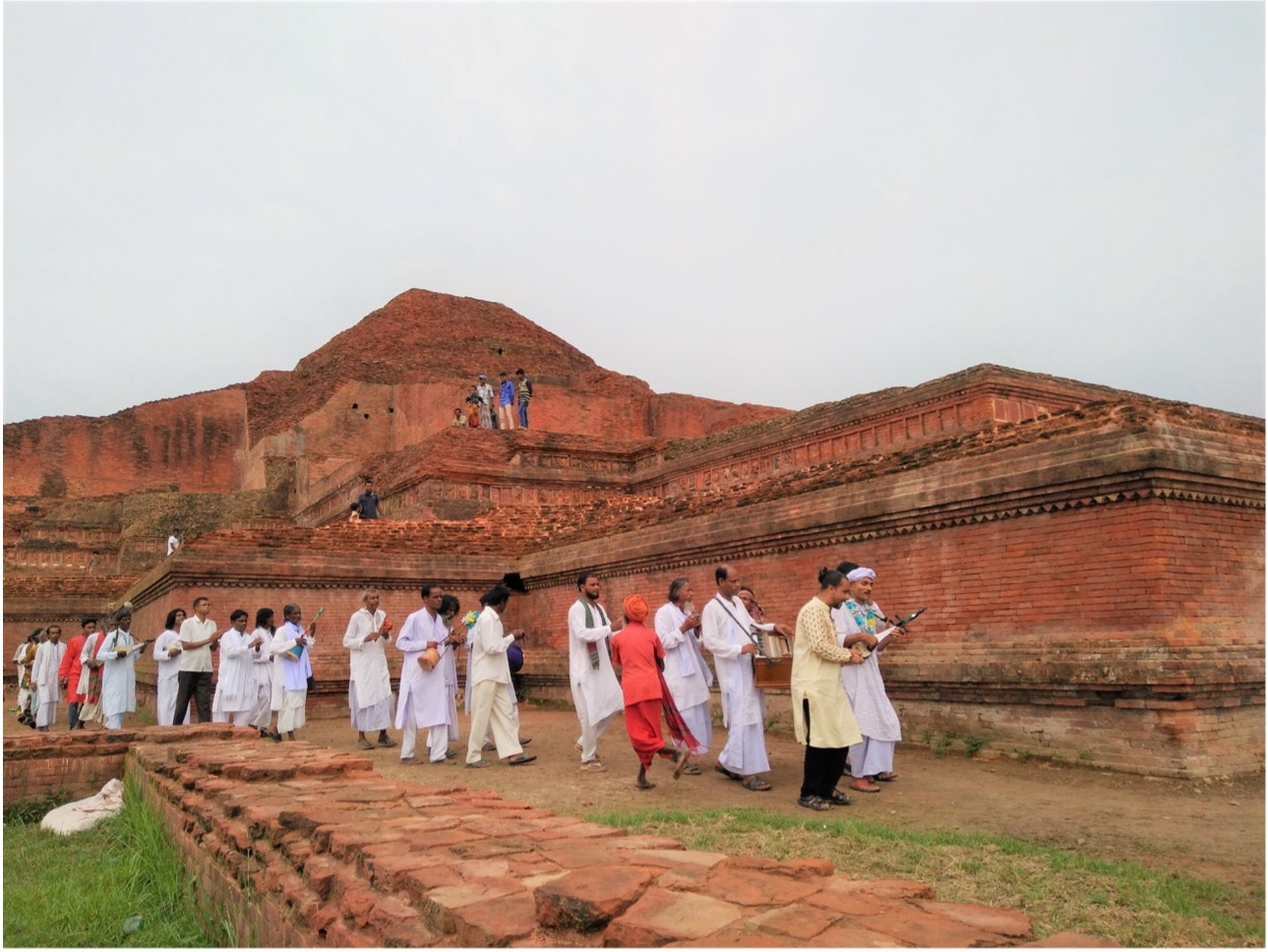
Revival of songs of the Charyapada by Baul-Fakir community of Naogaon district, at UNESCO World Heritage site Paharpur Buddhist Temple, 2016 © Pantho Proshad
Vabnagar Foundation, since its establishment, has keenly observed the growing socio-cultural and political neglect that has led to the gradual erosion of Bangladesh’s rich, multidimensional cultural heritage. This neglect has created fertile ground for the spread of radical religious fundamentalism, which in turn has had a significant impact on the cultural psychology of the nation. With this growing shift, many people have begun turning away from traditional cultural practices, leading to a crisis in the preservation and understanding of their heritage. Against this backdrop, Vabnagar Foundation has launched a revival program focused on one of Bangladesh‘s oldest cultural treasures–the Charyapada, a collection of Buddhist mystic songs from ancient Bengal. This program seeks to reconnect people with the deep antiquity of Bangladesh’s cultural heritage, while also promoting an inclusive, liberal, and humane understanding of cultural knowledge.
The aim of the program is to revive and highlight the songs of Charyapada, a crucial part of Bangladesh‘s intangible heritage, to not only showcase the antiquity of these traditions but also to awaken a sense of unity, harmony, and equality among people. One of the key objectives is to increase awareness of the liberal, humanistic cultural practices that were integral to ancient Bengal. Vabnagar Foundation’s integrates promoting equality between genders, as well as among people of various faiths and identities. This is in keeping with the inclusive nature of the Charyapada and the legacy of the Baul-Fakir tradition, which bas long been an important social force in Bangladesh. The Baul-Fakir community, with their emphasis on universal humanism and spiritual enlightenment, bas played a pivotal role in preserving and spreading harmony through their music. Therefore, the Baul-Fakirs have been ensured full participation in the revival program, as their tradition of fostering societal unity aligns with the program‘s objectives.
The relationship between Charyapada and the Baul-Fakir tradition is well-documented. Mahamahopadhyaya Haraprasad Shastri, a leading scholar, called Charyapada the origin of many forms of devotional music in Bengal, including the popular Kirtan and Baul songs. Music historian Rajeshwar Mitra, however, pointed out that other musical genres were prevalent before Charyapada, and he argued that the songs of the Baul-Fakir community evolved from a variety of influences. Despite these differences in scholarly opinion, there is no doubt that the Baul-Fakir tradition is deeply connected to the songs of Charyapada. Several verses ofCharyapada mention words like ‘Bazil‘ and ‘Bajul’, which are believed to have been precursors to the Baul practice, as noted by scholars such as Dr. Ahmad Sharif. This link between the mysticism of Charyapada and the Baul-Fakir community is central to the Vabnagar Foundation‘s efforts in reviving these songs, as it emphasizes the continuity of cultural and spiritual practices across centuries.
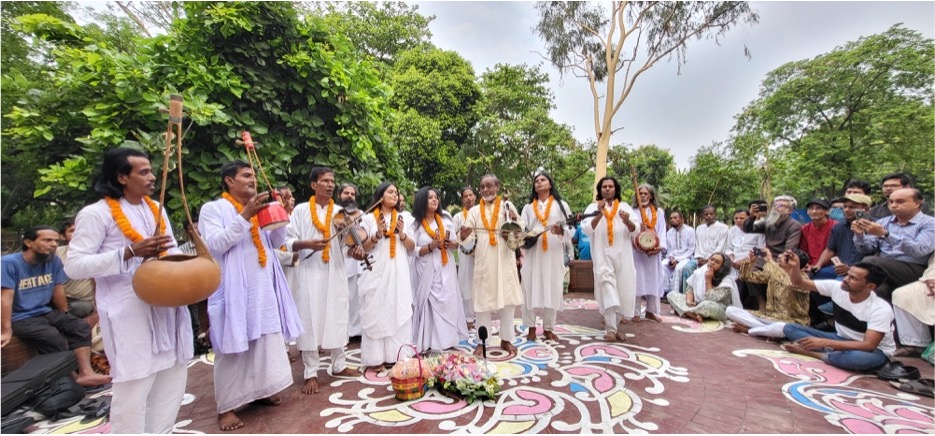
Bhabanagara Sadhusongo, 501st sessions of revival of the Charyapada, on 9th May 2024 ©Saymon Zakaria
The revival of Charyapada was initiated through informal, home-based meetings, where members of the Baul-Fakir community, along with university faculty from the music department, began discussions on the tradition’s revival. Interestingly, during one such meeting, a miraculous event occurred when a melodic interpretation of the first verse ofCharyapada emerged spontaneously from the depths of consciousness.
This moment was pivotal, as it led to the collective participation of the Baul-Fakir artists, marking the beginning of a new chapter in the revival of Charyapada. It was surprising to the participants that the melody followed the traditional style of North Bengal, aligning with one of the earliest forms of Charyapada music. The first verse, composed by the ancient poet Luipa, is now widely accepted and sung by many Baul-Fakirs in Bangladesh. This initial success of the revival program was a critical moment in the larger effort to reintegrate these ancient songs into modem cultural practices.
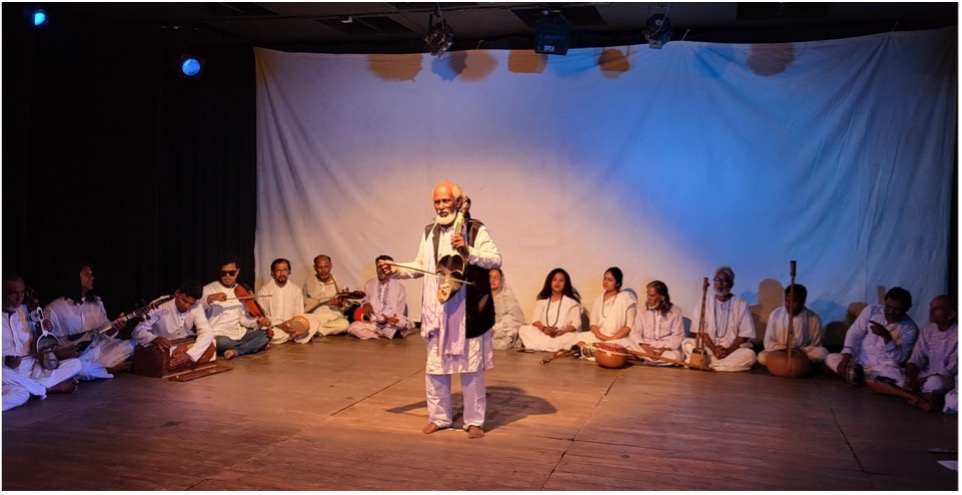
Fakir Abul Hashem (from Pabna distric) singing Charyapada on the stage of Bangladesh Shilpokola Academy ©Saymon Zakaria
To further this revival, Vabnagar Foundation ensured that the Baul-Fakir community’s participation was structured and systematic. Beginning in 2014, Yabnagar organized weekly Sadhusanga sessions in Dhaka, where Baul-Fakir artists from all over Bangladesh gathered to sing and preserve the songs ofCharyapada. By November 2024, as many as 524 episodes of these sessions had been held, marking a significant achievement in the program‘s goal to preserve this musical tradition. The participation of the Baul-Fakir community, scholars, poets, intellectuals, and researchers from Bangladesh and abroad is further enriching the tradition of Charyapada revival. This inclusion of a wide range of stakeholders ensures that the revival of Charyapada is not limited to a specific group but is a collective and inclusive endeavor.
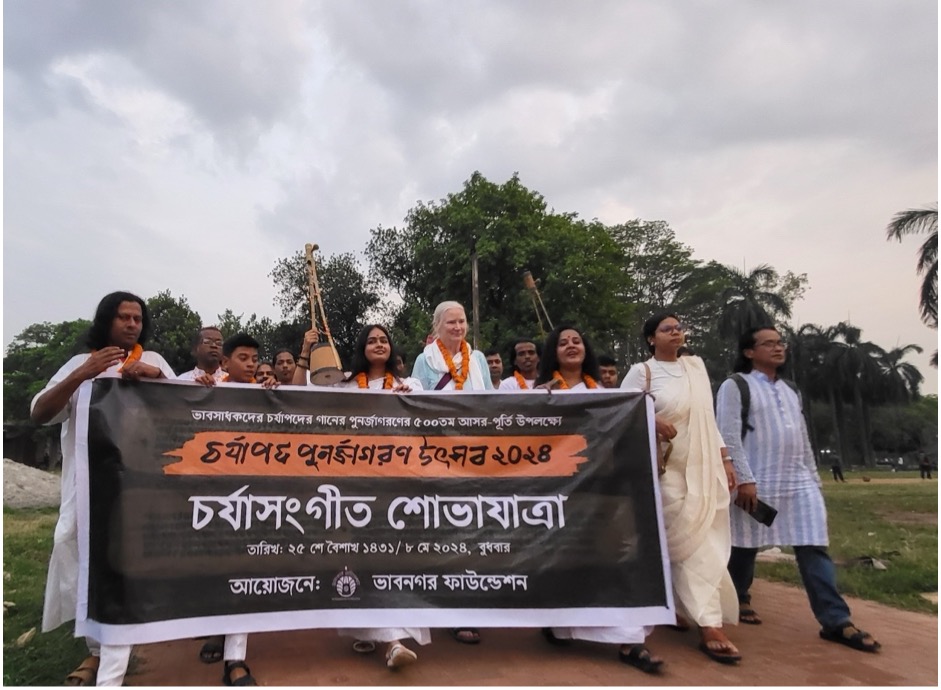
American scholar professor Rebecca J. Manring had participated in the procession of the Charyapada Revival Festival 2024 with the Baul-Fakir community. ©Saymon Zakaria
Additionally, Vabnagar has organized numerous workshops and training programs to teach the songs of Charyapada. These workshops, held in various districts of Bangladesh, are often attended by both junior and senior Baul-Fakir artists, as well as other interested community members. Some key centers for the revival of Charyapada have been established in locations such as Naogaon’s Somapura Mahavihara (a UNESCO World Heritage site), Pabna, Kishoreganj, Chuadanga, Jhenaidah, Sunamganj, Comilla, and Chittagong. These centers serve as hubs for the practice and performance of Charyapada, with local artists playing a significant role in maintaining and sharing the tradition at the grassroots level. Moreover, these centers have also contributed to national-level performances of Charyapada at prestigious institutions like the Bangla Academy, the Bangladesh National Museum, and the Bangladesh Folk and Crafts Museum.
The success of the Vabnagar Foundation‘s revival efforts is also evident in the international recognition the program has received. For example, Baul-Fakir artists have performed Charyapada songs at the South Asia Institute in Chicago, USA, the UNESCO Research Institute IRCI in Osaka, Japan, and Karunanithi Sangeet Mahavidyalaya, Nepal. Notably, Baul-Sadhika Srijoni Tania, a key artist in the revival program, performed Charyapada at the Goethe-Institut in Kolkata, India, and has trained students at the University of Chicago’s Department of Music. This international exposure has allowed Charyapada to reach global audiences and foster cross-cultural appreciation for Bangladesh‘s musical heritage.
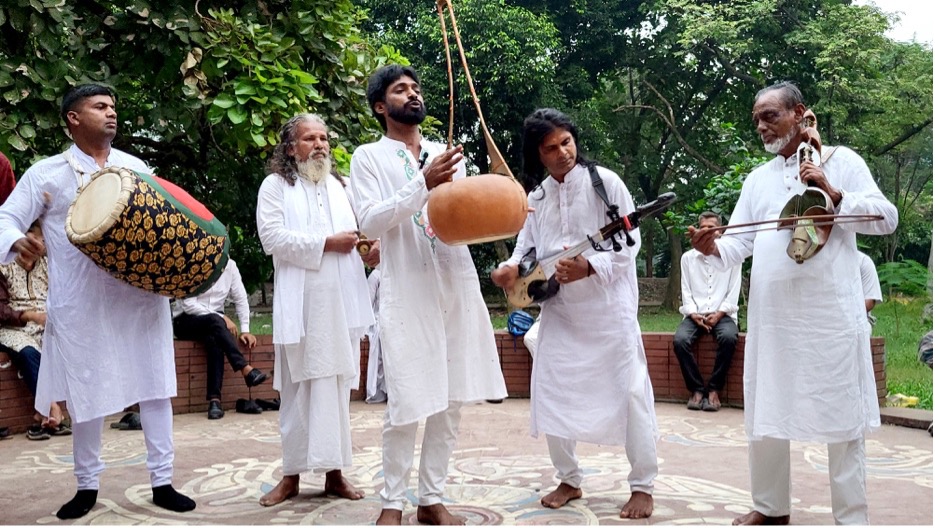
Robiul Haque has performing Charyapada with the Baul-Fakir community at the Bhabanagara Sadhusongo. ©Saymon Zakaria
Through Vabnagar‘s efforts, Charyapada has found a new home in contemporary Bengali culture. The foundation‘s initiative involves two primary objectives: first, to protect the musical creativity of the Baul-Fakir artists and preserve their unique skills in composing and performing music, and second, to inspire the younger generation to engage with this musical tradition. By promoting the participation of Baul and Sufi artists alongside academically trained musicians, the program ensures that Charyapada remains both rooted in traditional practices and accessible to modern audiences. It is also notable that the program has promoted gender equality by providing equal opportunities for both male and female artists, as well as including people with disabilities.
One of the significant challenges faced by Baul-Fakir artists is their financial instability. Many of these artists engage in music as a part-time profession, while others take on additional jobs to support their families. This financial insecurity sometimes makes it difficult for the artists to fully devote themselves to the revival of Charyapada. To address this issue, Vabnagar Foundation provides financial support to many Baul-Fakir artists, ensuring that they can continue their work without financial burden. Additionally, the foundation has been instrumental in organizing performances and events, which provide the artists with opportunities for recognition and exposure. These efforts help raise awareness about the importance of preserving Charyapada while also supporting the artists who keep this tradition alive.
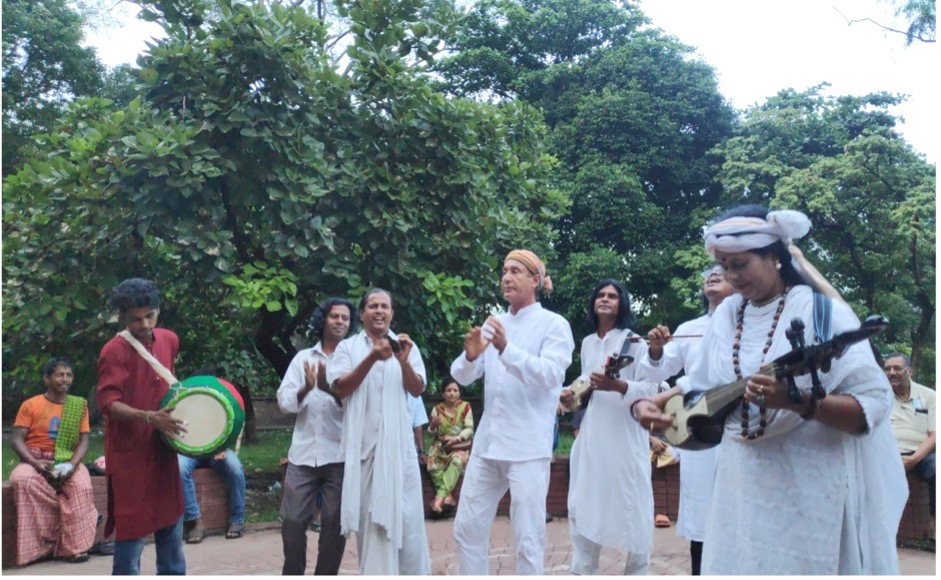
The weekly event of Revival of songs of the Charyapada, at the Bhabanagara Sadhusongo. ©Saymon Zakaria
The Vabnagar Foundation‘s program to revive the ancient Bengali Buddhist mystic songs of Charyapada has thus made significant strides in preserving and promoting Charyapada to create living practices. The inclusion of the Baul-Fakir community, the dedication to inclusivity, and the integration of both traditional and modem musical practices have helped to ensure the survival ofCharyapada for future generations. Through workshops, performances, and international exposure, the foundation has not only revitalized this ancient tradition but has also fostered a sense of pride and unity an1ong the people of Bangladesh. It has proven to be a powerful example of how cultural heritage can be preserved and rejuvenated through the collective efforts of communities, artists, and institutions.
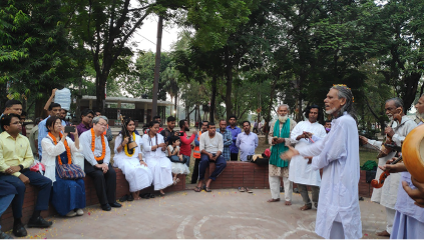
Shah Alom Dewan (from Barishal distric) singing Charyapada in the front of the Director General and Head of the research of IRCI, Japan. ©Saymon Zakaria
The right to lead the Baul-Fakir community in safeguarding the renaissance tradition of the ancient Bengali Buddhist mystic songs ofCharyapada has been confirmed from the beginning. First of all, since Charyapada is the oldest music of the body-centered Baul saints in Bangladesh, we were aware that the Bauls should have leadership in composing, practicing, training and performing this type ofsong. Upto this point, Vabnagar Foundation hasconducted workshopson songs ofCharyapada, and mainly Baul-Fakir artists have provided the training. This instilled a kind of confidence and conviction among Baul-Fakir artists that their role in preserving and safeguarding the legacy of the ancient Bengali Buddhist mystic songs ofCharyapada is paramount. To ensure the participation of Baul-Fakirs, Vabnagar Foundation takes an exceptional approach, that is to ensure the right of Baul-Fakirs to compose the tunes of ancient Bengali songs. But this task was not easy at first. Because, the ancient language of the Charyapada is quite unintelligible. In this case, with the consideration of making the songs of the Charyapada understandable to the contemporary people, the Baul-Fakir artists of Bangladesh were inspired to compose and perfom1 the songs ofCharyapada as converted into songs in the contemporary Bengali language. Through their composition and performance, the sentiments of the fifty Charyapada songs are shared by the common people of Bangladesh today and have been accepted as traditions. Our methods include:
- Presenting the ancient Charyapada through folk melodies,
- Performance of ancient songs of Charyapada in modern Bengali language in folk tunes,
- Presentation of Charyapada converted into ancient Bengali and contemporary Bengali in folk tunes,
- Charyapada performance converted into contemporary Bengali language following the raga of Charyapada, and
- Charyapada renderings in ancient Bengali following the ragas indicated at the top of the ancient manuscripts.
Following the above 5 methods, the revival ofCharyapada among the devotees of Bangladesh has become acceptable at the national and international level. The most important aspect of this program ofVabnagar Foundation is to ensure community participation in the development, propagation, and protection of traditional culture in a creative process where every creative Baul-Fakir artist has an opportunity to apply his creativity. As a result, regional diversity is evident in the tunes of each Charyapada song of ancient Bengal. Our flexible use of tradition allows for innovation as well, since each artist gets an opportunity to express his creative talent while perfonning his or her own melodic interpretations of Charyapada songs.
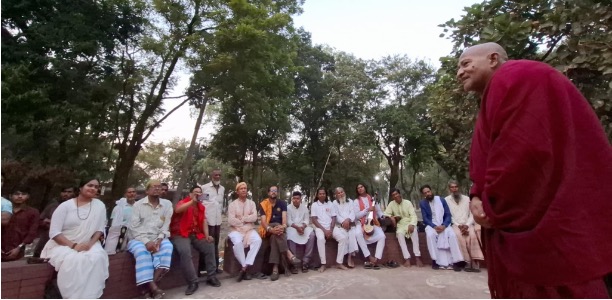
Buddhist Monk Professor Jinabodhi Bhikkhu Speaks on the Revival of Ancient Bengali Buddhist Songs of Charyapada at Bhabanagara Sadhusongo. ©Saymon Zakaria
Vabnagar Foundation’s initiative to revive the ancient Buddhist mystic songs of the Charyapada has gained significant momentum, primarily through the weekly gatherings of the Vabnagar Sadhusanga. Additionally, the Foundation has expanded its efforts to raise awareness and engage a wider audience through social media platforms, with recorded sessions from Sadhusanga shared on Facebook and YouTube. Documentaries about the Charyapada tradition have also been aired on various television channels, including Bangladesh’s national broadcaster, Bangladesh Television. These efforts have played a crucial role in increasing public interest in the Charyapada songs, not only in Bangladesh but also among artists and cultural enthusiasts from regions outside Bangladesh, particularly from West Bengal, Assam, and other parts of India. Many people have drawn parallels between the Charyapada songs and the cultural heritage of their respective regions, fueling further interest in the revival movement.
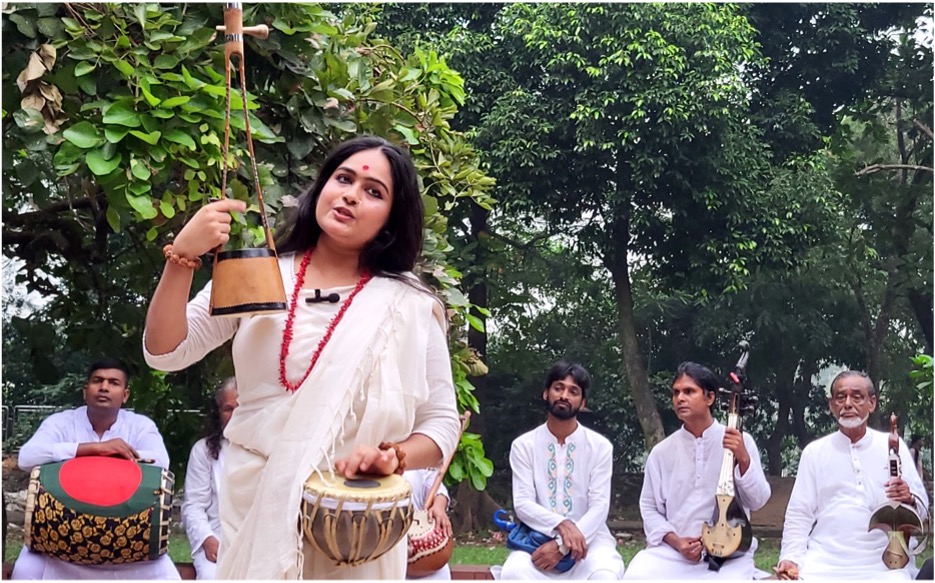
Sadhika Srijoni Tania singing Charyapada following the original raga. ©Saymon Zakaria
As mentioned before, Vabnagar Foundation has made a concerted effort to ensure the direct participation of the Baul-Fakir community in safeguarding and reviving the tradition of Charyapada. This initiative has proven successful, particularly because it utilizes the traditional methods of performing Charyapada, which are inherent to the Baul-Fakir community. While earlier efforts by institutionally educated musicians and cultural figures in Bangladesh to revive Charyapada songs were well-intentioned, they were largely unsuccessful due to their individualistic approach. However, when the Vabnagar Foundation integrated the Baul-Fakir community into the revival process, it became a collective effort that highlighted the deep roots of the Baul-Fakir song tradition.
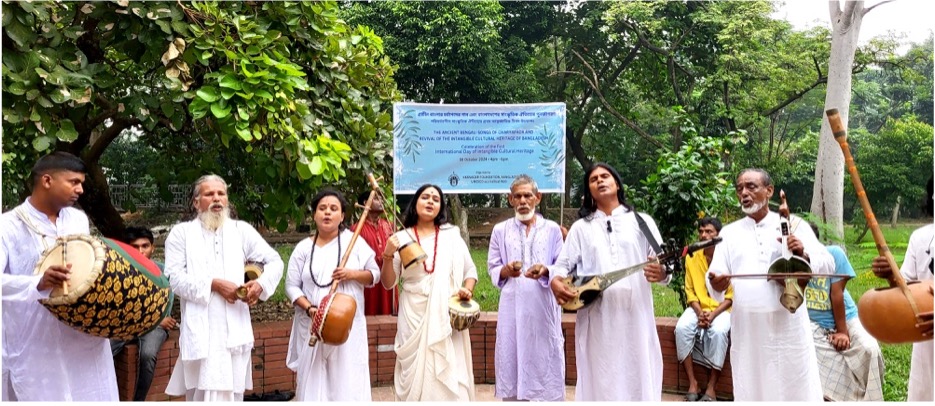
Vabnagar Foundation celebrates 1st International day of Intangible Cultural Heritage at the revival of Charyapada in Bhabanagara Sadhusongo. ©Saymon Zakaria
When the Vabnagar Foundation began its revival program with the direct participation of the Baul-Fakir artists, it faced significant opposition and controversy. Some critics, including educated cultural personalities and musicians, argued that the language of the Charyapada songs was archaic and thus difficult for the common Baul-Fakir practitioners to understand. Others contended that since the Baul-Fakir artists lacked classical music training, they were unqualified to perform the sophisticated Charyapada songs. Additionally, some believed that performing Charyapada songs in traditional folk tunes was inappropriate. This criticism threatened to derail the project, as some people attempted to hinder the revival efforts by undem1ining the Baul-Fakir community’s involvement.
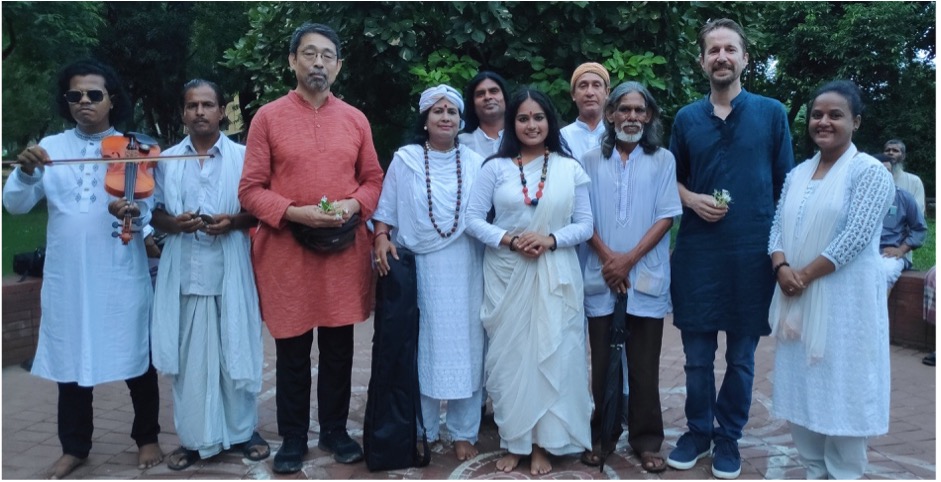
Prof Mashahoko Togawa (Japan) and Prof Jeremie Codron (France) with Baul-Fakir community, at the Bhabanagara Sadhusongo. ©Saymon Zakaria
In response to these criticisms, the Baul-Fakir artists involved in the revival program took the initiative to address the concerns and clarify the cultural significance of their participation. The artists provided explanations and interpretations of the Charyapada songs, often before or after their performances, offering insights into the deep, body-centered traditions of the Charyapada practice (siidhanti).They also highlighted the connections between the Charyapada songs and the Baul-Fakir tradition, which helped to counter the criticisms regarding the artists‘ lack of formal music education. This approach not only quelled the controversy but also solidified the Baul-Fakir community’s role in the revival process.
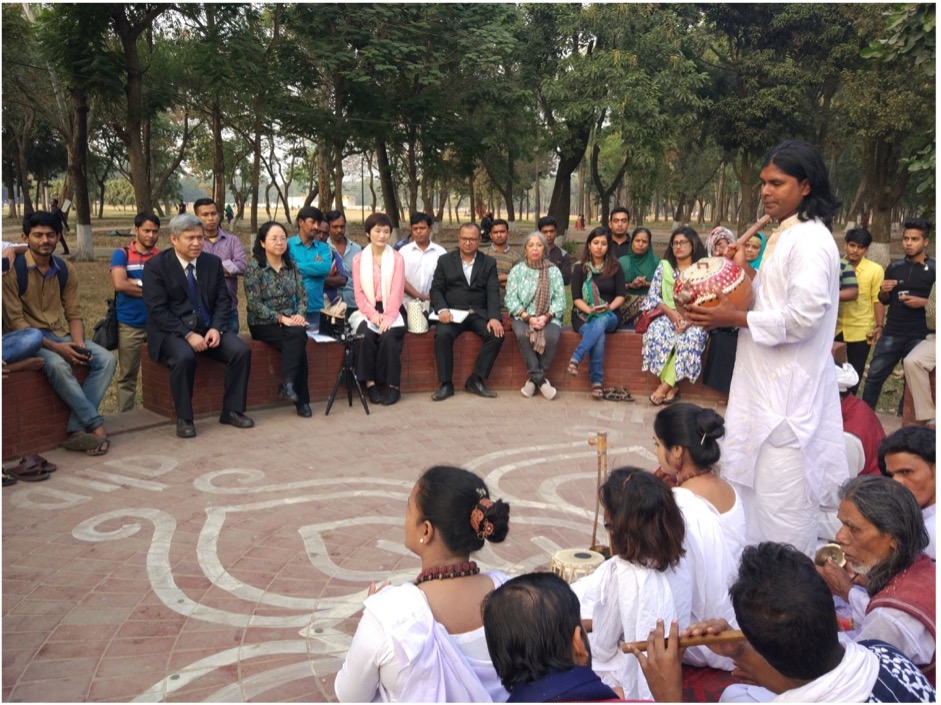
Prof Zhang Boyu (Director, Intangible Cultural Heritage Research Center, China) visited with his colleague to observe the revival of Charyapada, at Bhabanagar sadhusongo. ©Saymon Zakaria
Moreover, scholars associated with the Vabnagar Foundation wrote and published academic articles that examined the significance of reviving Charyapada songs with the Baul-Fakir community’s involvement. These writings helped to clarify the cultural, historical, and musical value of the revival program, garnering wider support. At the same time, the performance practices of the Charyapada songs have continually evolved and improved within the Baul-Fakir community. The songs are promoted on social media, YouTube, and television, helping to keep the tradition and their innovative interpretations alive. As a result, the Yabnagar Foundation‘s efforts to revive Charyapada songs have garnered national and international acclaim.
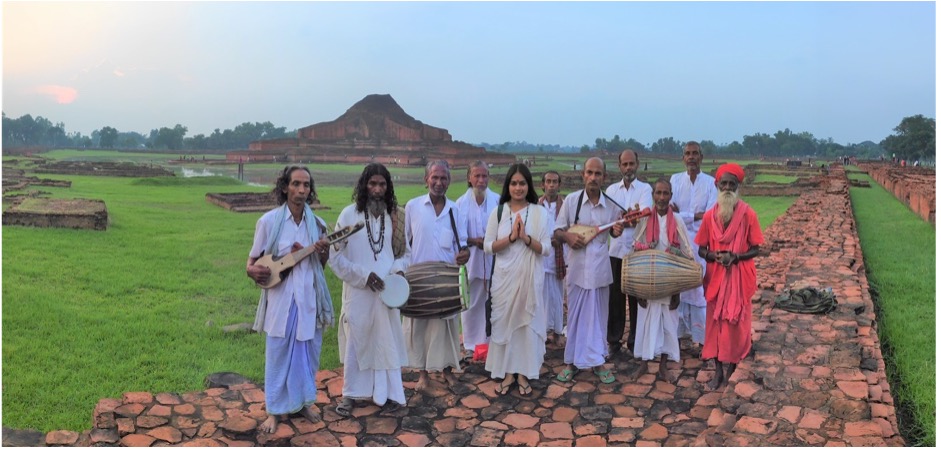
The team of the revival of songs of the Charyapada by Baul-Fakir community of Naogaon district, at UNESCO World Heritage site Paharpur Buddhist Temple, 2022. ©Saymon Zakaria
Interestingly, the controversies that initially surrounded the revival program may have indirectly contributed to its success. The debates surrounding the appropriateness of the Baul-Fakir community’s involvement in the revival program piqued the curiosity of many people, leading them to explore the Vabnagar Foundation‘s work further. As more individuals learned about the revival of Charyapada songs, they became interested in joining the Vabnagar Sadhusanga, thus expanding the program‘s reach.
The impact of the revival program has not gone unnoticed by scholars and cultural experts. Dr. Karunamaya Goswami, a renowned musicologist and author of a music encyclopedia in Bangladesh, praised the Baul-Fakir artists‘ contributions to the Charyapada revival. He highlighted how the Baul-Fakir artists had successfully merged Charyapada with broader folk music traditions, bringing the ancient songs into contemporary life. According to him, this approach made Charyapada more accessible as living music, which is a significant achievement.
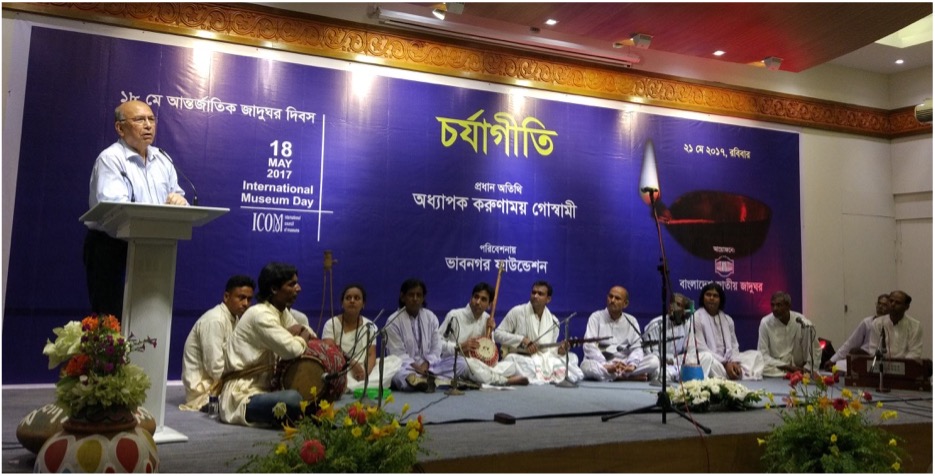
Dr. Karunamaya Goswami, Musicologist and Author of Sangeet Kosh, Supports the Revival of Charyapada in a Speech Organized by the Bangladesh National Museum, 2017. ©Saymon Zakaria
Professor Dipesh Chakraborty, a historian from the University of Chicago, also acknowledged the importance of the Charyapada revival. He attended a performance ofCharyapada songs at the South Asia Institute in Chicago in 2023 and was impressed by the way the Baul-Fakir artists combined traditional written ragas with folk music elements. Professor Chakraborty appreciated the flexibility shown by the performers in blending the ancient music with modern folk genres, breaking away from rigid traditions. This adaptability, he noted, was a welcome development in preserving and promoting the Charyapada songs.
The Vabnagar Foundation’s revival program has thus benefited from both positive and dissenting opinions. Thedisagreements and controversies surrounding the project have, in some cases, helped to generate interest and draw attention to the Charyapada revival. The program‘s success can be attributed to the active participation of the Baul-Fakir community, the continuous improvement of performance practices, and the broader public engagement achieved through media and academic support. The Vabnagar Foundation’s initiative has not only safeguarded the Charyapada tradition but also made it more relevant to contemporary audiences, ensuring that it continues to thrive for future generations.
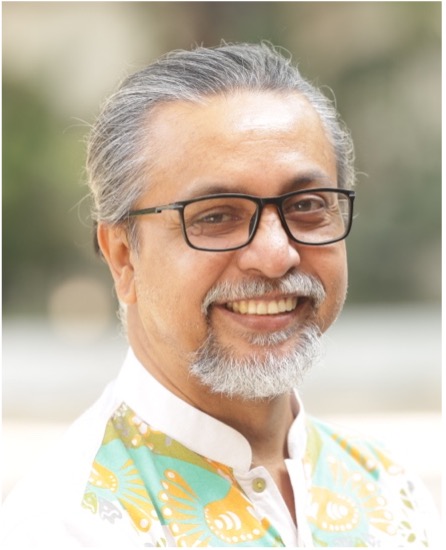 SAYMON ZAKARIA writer, researcher, and Deputy Director of the Bangla Academy. Besides, he is Chairperson of Vabnagar Foundation.
He is internationally recognized for his ethnographic field-surveys that relate to Intangible Cultural Heritage (ICH).
He has delivered academic lectures on language, literature, and culture to the University of Chicago, the University of Pennsylvania, the University of California (Santa Barbara), the University of Washington, the Tokyo University of Foreign Studies, the Sapientia-Hungarian University of Transylvania, and International Research
Centre for Intangible Cultural Heritage in theAsia-Pacific Region (IRCI), Osaka,
Japan. Additionally, he has attended and conducted various workshops in France, Sri Lanka, Turkey, Kyrgyz Republic, Nepal, Philippines, Morocco and different regions oflndia.
He is an editor of Bhiibanagara: International Journal of Bengal Studies.
He received his PhD on The Traditional Theater in Bangladesh: Content and Mode of Language. His MPhil was on The Characters of Rama and Sita in the Popular Versions of the Ramayana in Bangladesh.
He received Bangla Academy Literary Award 2019.
Major Publications: Prachin Banglar BuddhoNatok (The Buddhist Theatre in Ancient Bengal), 2007; Bangladesher Lokonatok: Bisoy o Angik-Boychittra (Folk-Theatre in Bangladesh : Variation of Content and Phenomenon), 2008; Pronomohi Bongomata: indigenous Cultural Forms of Bangladesh, 2017; City of Mirrors: Songs of Liilan Sai, (Co-editor), Oxford University Press 2017; Traditional Music instruments of Bangladesh, 2018.
Revival of Ancient Bengali Buddhist Mystic Songs of Charyapada:ACollaborative, Community-Based Approach to Safeguarding Living Heritage by Saymon Zakaria. Edited by Keith E. Cantu and Nurunnabi Shanto. Cover design : Md. Saiful Islam. Published by Sadhika Srijoni Tania, Vabnagar Foundation, House 86, Road 7, Block C, Monsurabad RIA, Mohammadpur, Dhaka 120, Bangladesh. December 2024. Email: vabnagarfoundation@gmail.com
Website: www.bhabanagarafoundation.org
Download PDF: Zakaria, S. Revival of Charyapada.pdf